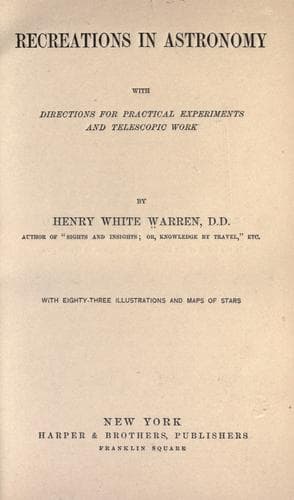
Recreations in Astronomy: With Directions for Practical Experiments and Telescopic WorkWarren, Henry White
Religion
Recreations in Astronomy: With Directions for Practical Experiments and Telescopic Work
Warren, Henry White
Astronomy
The next difficulty is that of rotation. The laws [Page 186] of
science compel a contraction into one non-rotating body--a central
sun, indeed, but no planets about it. Laplace cleverly evades the
difficulty by not taking from the hand of the Creator diffused gas,
but a sun with an atmosphere filling space to the orbit of Neptune,
and _already in revolution_. He says: "It is four millions to one
that all motions of the planets, rotations and revolutions, were at
once imparted by an original common cause, of which we know neither
the nature nor the epoch." Helmholtz says of rotation, "the
existence of which must be assumed." Professor Newcomb says that the
planets would not be arranged as now, each one twice as far from the
sun as the next interior one, and the outer ones made first, but
that all would be made into planets at once, and the small inner
ones quite likely to cool off more rapidly.
It is a very serious difficulty that at least one satellite does
not revolve in the right direction. How Neptune or Uranus could
throw their moons backward from its equator is not easily accounted
for. It is at least one Parthian arrow at the system, not necessarily
fatal, but certainly dangerous.
A greater difficulty is presented by the recently discovered satellites
of Mars. The inner one goes round the planet in one-third part of
the time of the latter's revolution. How Mars could impart three
times the speed to a body flying off its surface that it has itself,
has caused several defenders of the hypothesis to rush forward
with explanations, but none with anything more than mere imaginary
collisions with some comet. It is to be noticed that accounting for
three times the speed is not enough; for as Mars shrunk away from
the [Page 187] ring that formed that satellite, it ought itself to
attain more speed, as the sun revolves faster than its planets, and
the earth faster than its moon. In defending the hypothesis, Mitchel
said: "Suppose we had discovered that it required more time for
Saturn or Jupiter to rotate on their axes than for their nearest
moon to revolve round them in its orbit; this would have falsified
the theory." It is also asserted that the newly discovered planet
Vulcan makes an orbital in less time than the sun makes an axial
revolution.
Public-domain text, read in full here on John Shaqi.
Reviews
Reviews
No reviews yet
Be the first to share your thoughts on this work.
Elsewhere in the archive
Join the Discussion
Join the discussion
Sign in to leave a comment or review.
Sign InorCreate an account