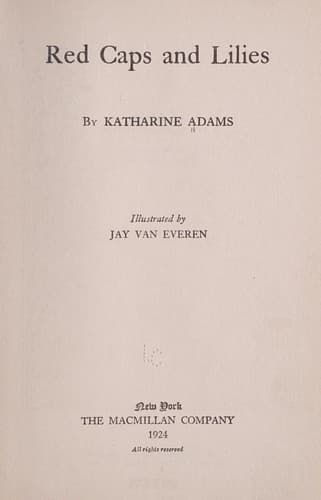
Children and war -- Juvenile fiction; France -- History -- Revolution, 1789-1799 -- Juvenile fiction
Jean ran across the field and into the wood beyond. Every now and then
he would give a clear, high call and then he would stop and listen. Once
there was an answering call and then he laughed and his thin little face
with its funny dimple wrinkled with delight.
“I’m happy and that’s why the lark answered. They never do if I’m
cross,” he thought, and began to sing: “Tra la la, tra la la! They’ll be
here the day after to-morrow. I shall hide behind the poplar trees by
the gate and see them drive in!”
The way was long through the wood, which was part of the Saint Frère
demesne, but it was beautiful and the air was cool and fragrant. After a
while Jean began to run. It was fun to run in and out of the sweet
greenness, always following the path which ended finally at a low stone
paling. Jean could see, not far off, the towering arch of the great
entrance way to the vast estate. He was never allowed to go in and out
that way. He climbed the paling and ran across a field until he came to
a dusty highway. He shuffled along the road, enjoying the thick clouds
of dust that he raised about him. Little Mademoiselle would be coming in
two days! He was on his way to his cousins—that was the only bit of
blackness on his horizon. His cousins lived in one of a row of poor
hovels situated some little way back from the roadside. Women sat in the
rude doorways, glad of a breath of the fresh air. They were gaunt,
sad-looking women, old long before their time because of years of heavy
work in the fields, little food, and no rest at all. Children swarmed
about the doorways and in the rough-looking stubble field beyond.
Jean stopped before the next to the last hut, where a lanky boy in
ragged clothes stood slouching against the doorway. He had a long, ugly
face and he was so thin that he seemed nothing but bones and eyes. He
snatched one of the loaves of bread from under Jean’s arm and began
eating it, tearing at the end of it with his teeth. The second loaf and
the towel fell to the ground as Jean caught the other end of the loaf
that Grigge was devouring and pulled at it with all his might.
“You shall not eat it all up. The others shall have their share,” he
cried. But Grigge, who, in spite of his thinness, was stronger than
Jean, being two years his senior and used to rough work, pulled himself
away, bread and all, and went inside the hut. Jean turned around only to
find his two younger cousins and the children next door fighting for the
second loaf. He knew that there was nothing he could do to separate them
or reason with them and so, having brought the bread, he could only
leave them to fight it out. There were a dozen children now fighting for
the loaf. Jean watched them for a moment and then turned back toward
home. A voice called to him from the doorway in mocking tones. It was
Grigge. He spoke between mouthfuls.
“You think you are very fine because you live with the gentry. You think
you are a prince because you live within the gates!”
Public-domain text, read in full here on John Shaqi.
Reviews
Reviews
No reviews yet
Be the first to share your thoughts on this work.
Join the Discussion
Join the discussion
Sign in to leave a comment or review.
Sign InorCreate an account