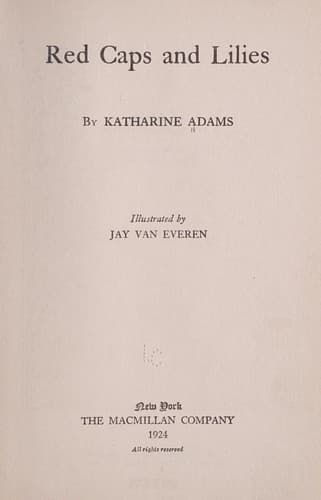
Children and war -- Juvenile fiction; France -- History -- Revolution, 1789-1799 -- Juvenile fiction
“Le Pont is in a dream, surely, but I am glad. I was excited and didn’t
realize what a scrape they would be in!” [Illustration: Le Pont] Years
later Marie Josephine remembered the incident; in fact she never really
forgot it. There were times when she could shut her eyes and see, in
that uncanny way in which we do see long-ago things, the old coach, the
faded coat of arms that had not been regilded that summer, the old blue
lining, the warm August sun streaming in, bringing with it the odor of
freshly cut hay and oats, thin rows of poplars rising against the
startling blue of the sky, and the peasant women bending over their work
in the field beyond. She could see Denise’s astonished gaze, from under
her lace hood. She always remembered the words and the whole incident
because it was the beginning of the great change. Madame le Pont was
right. Things that had mattered so much were beginning to be not so
important. There would be a time when they would not matter at all.
CHAPTER VI
AUGUST TENTH, 1792
Lisle and his mother had finished their déjeuner in the great dining
room of the Paris house. The tall, gilded clock in the entrance hall had
just struck twelve. All through the meal the cannons in the Carrousel,
the inner court of the Tuileries palace, less than a mile away, had
thundered outside. The glass chandelier above the table had shaken until
its chains, jangling together, made a sound like music in the dim, vast
room. The amber-colored velvet curtains at the windows were drawn
closely together and the room was lighted by four candles in gold
candlesticks on the table.
Lisle piled his nutshells in a heap on his plate. He had something to
tell his mother and he did not know how to go about it. There was a dish
of fruit on the table, as well as a carved bowl full of nuts and a
carafe of wine and one of water, and even a bowl of flowers, a few red
roses which Henri had picked that morning from the vine by the coach
house. The comtesse leaned forward and picked one from the white bowl
and held it to her face. Then she said what she had been thinking all
through the meal:
“Nothing would matter if only you had gone with the others, Lisle. Why
did I let you stay!”
“Because you knew that I would not go!” Lisle answered.
She looked at him and he returned her look steadily.
“I’m not a child any longer. I’m fifteen and a half and the head of the
house,” he went on. “I’ve stayed to see Paris now. I want to see what
happens.”
The comtesse put both hands over her eyes and sat that way for a moment.
It was as though she would shut out all the confusion and worry of the
past weeks and months, especially of the last two days.
Public-domain text, read in full here on John Shaqi.
Reviews
Reviews
No reviews yet
Be the first to share your thoughts on this work.
Join the Discussion
Join the discussion
Sign in to leave a comment or review.
Sign InorCreate an account