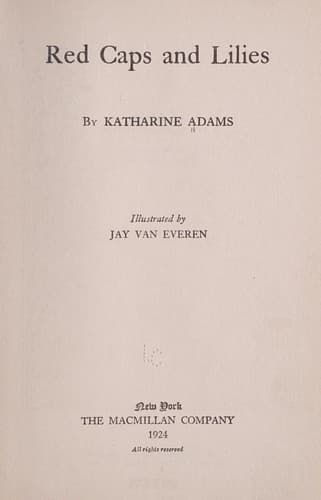
Children and war -- Juvenile fiction; France -- History -- Revolution, 1789-1799 -- Juvenile fiction
Lisle was thinking deeply, while he drank the glass of milk and ate the
cakes. He went over in his mind the events of a fortnight ago—his
sudden, unbelievable capture, the rush through the fury of the storm,
then warmth, the smell of baking, this room, and the bakery woman! He
had never seen his captors. They had left him blindfolded inside the
room, and the woman had come in shortly afterward!
He knew that the bakery woman was kind and he was grateful to her. He
knew that as a prisoner he might have had to suffer physically in ways
that he would have found it hard to bear. Here there was no filth or
misery. There was good food and a comfortable bed. There was even a
little mouse who came out and wabbled its nose at him now and then. He
particularly enjoyed this because he had read stories in which prisoners
made friends with mice and rats. It made his captivity more interesting
to him. He felt certain that the bakery woman would not lift a finger to
help him to escape, and he was right. She was not of the stuff of which
heroines are made. She would not do anything to change the peaceful,
even course of her bakery existence. No, he must not look to her for
more than everyday comfort! Where, then, could he look?
He thought constantly of Rosanne, more so than of his mother, for he
knew where his mother was, or, at least, where she was supposed to be,
while of Rosanne he knew nothing at all, except that he had left her
singing in the salon when he went to the cellar for the wood. More than
anything else he longed to know that she was safe. He did not dare to
mention her to the bakery woman, because he did not want to call
attention to her at all. There was nothing then that he could do, but
wait.
He asked the bakery woman for ink and a pen soon after his coming. She
had protested at first, but had finally brought him a dish of ink and a
long, fine quill pen. She herself used such articles only for her
accounts, writing not being one of her best accomplishments. Lisle had
explained to her why he wanted them.
“There is nothing to do, don’t you see? Nothing. I have no books, and
you have none to give me. All prisoners have written accounts of their
life in prison. It is always done, and it will give me something to
think about!” he had said to her, and she had brought what he wanted,
when she had come up again with his food. He had begun a sort of diary,
and once when the mouse came out from his hole and winked at him while
he was writing, he felt as though he might be a part of an old novel. He
was a prisoner writing his diary, and his one friend was a mouse!
Public-domain text, read in full here on John Shaqi.
Reviews
Reviews
No reviews yet
Be the first to share your thoughts on this work.
Elsewhere in the archive
Join the Discussion
Join the discussion
Sign in to leave a comment or review.
Sign InorCreate an account