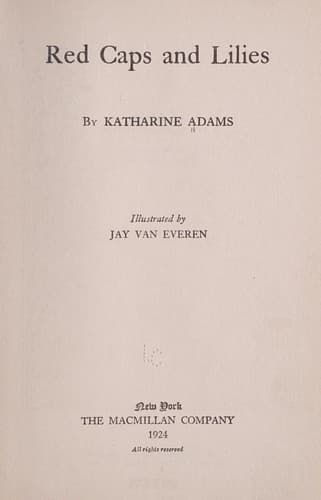
Children and war -- Juvenile fiction; France -- History -- Revolution, 1789-1799 -- Juvenile fiction
These were his happier moments. There were other times when he realized
his dire position so vividly that it seemed as though he must pound and
tear at the door until somehow he smashed it open, but he knew that it
would never give way. He knew that his mother had gone to Great-aunt
Hortense. More than that he could not know, and he dared not think too
much about his people. When he thought of Pigeon Valley, he found that
it was Dian who stood out among all others.
Meanwhile, Dian had walked the city from one end to another, making
friends as was his wont. He became acquainted with the market gardener
and went about with him to meetings of the different sections. Now and
then he spoke at the meetings. When he spoke, the wrangling generally
ceased for a moment, and the people listened—but only for a moment.
They had no use for the message of love that he had to give. Yet they
showed no animosity when his gentle, earnest face was seen among the
crowds and at public meetings. He never once lost faith in his belief
that the right way would be shown him. He was grateful that he had met
Raoul and his master, for being with them meant being with the people,
mingling with them freely. He had never gone through the Saint Frère
house again, as he did not wish to run the risk of meeting Henri. Each
night he slept in the hidden cellar and it was there that he thought
everything out. As he paced up and down the rough, uneven floor, Dian
thought that he would give up all that the future held for him of peace
and quiet days to have Lisle walking beside him.
When the bakery woman came in to see Lisle the next afternoon she
brought with her the cake she had baked for the seed shopman’s party.
The boy, Raoul, was to come for it at four o’clock. Her man was going to
the supper. There was to be roasted suckling pig. Indeed, it was to be a
fine affair and much discussion was to take place.
“They’ll talk, but they won’t get anywhere; they never do,” sniffed the
woman as she set the cake down on the table. It was already placed in
its wide green box, and it was surrounded by soft pink paper.
It was a superb, a fantastic cake—four tiers of golden fluff, with
glimpses of cream and marrons between layers and a gauze covering of
spun sugar holding it all in place. It was topped with a glittering
icing. The icing was festooned with candied apricots and cherries, in
the midst of which stood a little spun-sugar figure wearing a tiny
scarlet cap decorated with a tri-color rosette, the emblem of the
revolution!
Public-domain text, read in full here on John Shaqi.
Reviews
Reviews
No reviews yet
Be the first to share your thoughts on this work.
Elsewhere in the archive
Join the Discussion
Join the discussion
Sign in to leave a comment or review.
Sign InorCreate an account