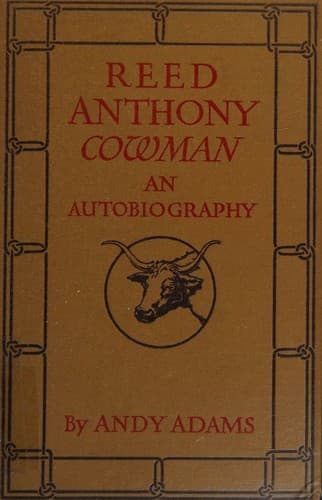
Reed Anthony, Cowman: An Autobiography — John Shaqi
Reed Anthony, Cowman: An AutobiographyAdams, Andy
History
Reed Anthony, Cowman: An Autobiography
Adams, Andy
Ranchers -- Fiction; Texas -- Fiction
Early in June the herd began to assume its required numbers. George
Edwards returned, and we naturally became bunkies, sharing our
blankets and having the same guard on night-herd. The drovers
encouraged all the men employed to bring along their firearms, and
when we were ready to start the camp looked like an arsenal. I had a
six-shooter, and my bunkie brought me a needle-gun from the ranch, so
that I felt armed for any emergency. Each of the men had a rifle
of some make or other, while a few of them had as many as four
pistols,--two in their belts and two in saddle holsters. It looked to
me as if this was to be a military expedition, and I began to wonder
if I had not had enough war the past few years, but kept quiet. The
start was made June 10, 1866, from the Brazos River, in what is now
Young County, the herd numbering twenty-two hundred big beeves. A
chuck-wagon, heavily loaded with supplies and drawn by six yoke of
fine oxen, a remuda of eighty-five saddle horses and mules, together
with seventeen men, constituted the outfit. Fort Sumner lay to the
northwest, and I was mildly surprised when the herd bore off to the
southwest. This was explained by young Goodnight, who was in charge
of the herd, saying that the only route then open or known was on our
present course to the Pecos River, and thence up that stream to our
destination.
Indian sign was noticed a few days after starting. Goodnight and
Loving both read it as easily as if it had been print,--the abandoned
camps, the course of arrival and departure, the number of horses,
indicating who and what they were, war or hunting parties--everything
apparently simple and plain as an alphabet to these plainsmen. Around
the camp-fire at night the chronicle of the Comanche tribe for the
last thirty years was reviewed, and their overbearing and defiant
attitude towards the people of Texas was discussed, not for my
benefit, as it was common history. Then for the first time I learned
that the Comanches had once mounted ten thousand warriors, had
frequently raided the country to the coast, carrying off horses
and white children, even dictating their own terms of peace to the
republic of Texas. At the last council, called for the purpose of
negotiating for the return of captive white children in possession of
the Comanches, the assembly had witnessed a dramatic termination. The
same indignity had been offered before, and borne by the whites, too
weak to resist the numbers of the Comanche tribe. In this latter
instance, one of the war chiefs, in spurning the remuneration offered
for the return of a certain white girl, haughtily walked into the
centre of the council, where an insult could be seen by all. His act,
a disgusting one, was anticipated, as it was not the first time it had
been witnessed, when one of the Texans present drew a six-shooter and
killed the chief in the act. The hatchet of the Comanche was instantly
dug up, and had not been buried at the time we were crossing a country
Public-domain text, read in full here on John Shaqi.
Reviews
Reviews
No reviews yet
Be the first to share your thoughts on this work.
Join the Discussion
Join the discussion
Sign in to leave a comment or review.
Sign InorCreate an account