Reed Anthony, Cowman: An Autobiography — John Shaqi
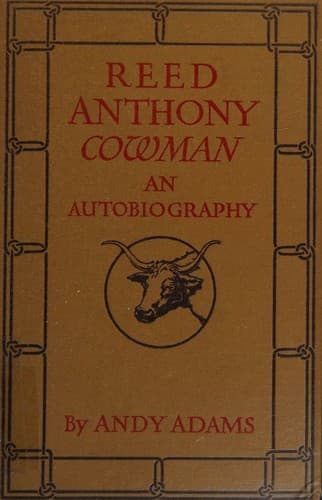
Reed Anthony, Cowman: An AutobiographyAdams, Andy
History
Reed Anthony, Cowman: An Autobiography
Adams, Andy
Ranchers -- Fiction; Texas -- Fiction
From Elm Creek to the beginning of the dry drive was one continual
struggle with stampeding cattle or warding off Indians. In spite of
careful handling, the herd became spoiled, and would run from the
howl of a wolf or the snort of a horse. The dark hour before dawn was
usually the crucial period, and until the arid belt was reached all
hands were aroused at two o'clock in the morning. The start was timed
so as to reach the dry drive during the full of the moon, and although
it was a test of endurance for man and beast, there was relief in
the desert waste--from the lurking savage--which recompensed for its
severity. Three sleepless nights were borne without a murmur, and on
our reaching Horsehead Crossing and watering the cattle they were
turned back on the mesa and freed for the time being. The presence of
Indian sign around the ford was the reason for turning loose, but at
the round-up the next morning the experiment proved a costly one, as
three hundred and sixty-three beeves were missing. The cattle were
nervous and feverish through suffering from thirst, and had they been
bedded closely, stampeding would have resulted, the foreman choosing
the least of two alternatives in scattering the herd. That night we
slept the sleep of exhausted men, and the next morning even awaited
the sun on the cattle before throwing them together, giving the Indian
thieves full ten hours the start. The stealing of cattle by the
Comanches was something unusual, and there was just reason for
believing that the present theft was instigated by renegade Mexicans,
allies in the war of '36. Three distinct trails left the range around
the Crossing, all heading south, each accompanied by fully fifty
horsemen. One contingent crossed the Pecos at an Indian trail about
twenty-five miles below Horsehead, another still below, while the
third continued on down the left bank of the river. Yankee Bill and
"Mocho" Wilson, a one-armed man, followed the latter trail, sighting
them late in the evening, but keeping well in the open. When the
Comanches had satisfied themselves that but two men were following
them, small bands of warriors dropped out under cover of the broken
country and attempted to gain the rear of our men. Wilson was an old
plainsman, and once he saw the hopelessness of recovering the cattle,
he and Yankee Bill began a cautious retreat. During the night and when
opposite the ford where the first contingent of beeves crossed, they
were waylaid, while returning, by the wily redskins. The nickering of
a pony warned them of the presence of the enemy, and circling wide,
they avoided an ambush, though pursued by the stealthy Comanches.
Wilson was mounted on a good horse, while Yankee Bill rode a mule, and
so closely were they pursued, that on reaching the first broken ground
Bill turned into a coulee, while Mocho bore off on an angle, firing
his six-shooter to attract the enemy after him. Yankee Bill told
us afterward how he held the muzzle of his mule for an hour on
Public-domain text, read in full here on John Shaqi.
Reviews
Reviews
No reviews yet
Be the first to share your thoughts on this work.
Join the Discussion
Join the discussion
Sign in to leave a comment or review.
Sign InorCreate an account