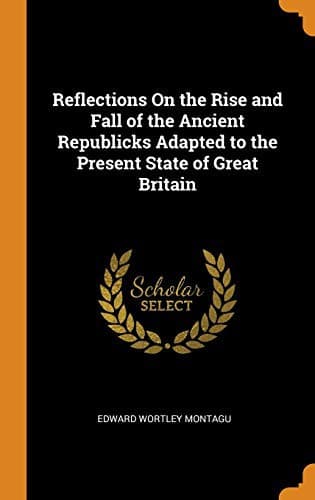
Reflections on the Rise and Fall of the Ancient Republicks: Adapted to the Present State of Great Britain — John Shaqi
Reflections on the Rise and Fall of the Ancient Republicks: Adapted to the Present State of Great BritainMontagu, Edward Wortley
Philosophy
Reflections on the Rise and Fall of the Ancient Republicks: Adapted to the Present State of Great Britain
Montagu, Edward Wortley
History, Ancient -- Philosophy; Republics
When arrived at the age of seven years, they were taken from the nurses,
and placed in their proper classes. The diet and clothing of all were
the same, just sufficient to support nature, and defend them from the
inclemency of the seasons; and they all lodged alike in the same
dormitory on beds of reeds, to which for the sake of warmth they were
all allowed in winter to add the down of thistles. Their sports and
exercises were such as contributed to render their limbs supple, and
their bodies compact and firm. They were accustomed to run up the
steepest rocks barefoot; and swimming, dancing, hunting, boxing, and
wrestling, were their constant diversions. Lycurgus was equally
solicitous in training up the youth to a habit of passive courage as
well as active. They were taught to despise pain no less than danger,
and to bear the severest scourgings with the most invincible constancy
and resolution. For to flinch under the strokes, or to exhibit the least
sign of any sense of pain, was deemed highly infamous.
Nor were the minds of the Spartan youth cultivated with less care. Their
learning, as Plutarch informs us, was sufficient for their occasions,
for Lycurgus admitted nothing but what was truly useful. They carefully
instilled into their tender minds the great duties of religion, and the
sacred indispensable obligation of an oath, and trained them up in the
best of sciences, the principles of wisdom and virtue. The love of
their country seemed to be almost innate; and this leading maxim, “that
every Spartan was the property of his country, and had no right over
himself,” was by the force of education incorporated into their very
nature.
When they arrived to manhood they were enrolled in their militia, and
allowed to be present in their publick assemblies: privileges which only
subjected them to a different discipline. For the employments and way of
living of the citizens of Sparta were fixed, and settled by as strict
regulations as in an army upon actual service. When they took the field,
indeed, the rigour of their discipline with respect to diet and the
ornament of their persons was much softened, so that the Spartans were
the only people in the universe, to whom the toils of war afforded ease
and relaxation. In fact, Lycurgus’s plan of civil government was
evidently designed to preserve his country free and independent, and to
form the minds of his citizens for the enjoyment of that rational and
manly happiness, which can find no place in a breast enslaved by the
pleasures of the senses, or ruffled by the passions; and the military
regulations which he established, were as plainly calculated for the
protection of his country from the encroachments of her ambitious
neighbours.[9] For he left no alternative to his people, but death or
victory; and he laid them under a necessity of observing those
regulations, by substituting the valour of the inhabitants in the place
of walls and fortifications for the defence of their city.
Public-domain text, read in full here on John Shaqi.
Reviews
Reviews
No reviews yet
Be the first to share your thoughts on this work.
Join the Discussion
Join the discussion
Sign in to leave a comment or review.
Sign InorCreate an account