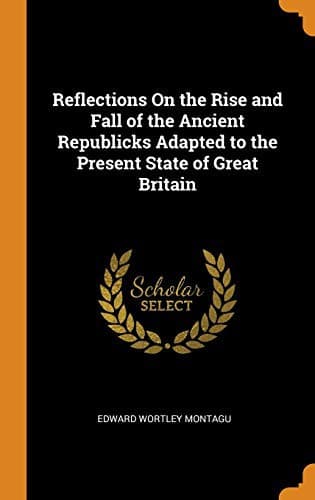
Reflections on the Rise and Fall of the Ancient Republicks: Adapted to the Present State of Great Britain — John Shaqi
Reflections on the Rise and Fall of the Ancient Republicks: Adapted to the Present State of Great BritainMontagu, Edward Wortley
Philosophy
Reflections on the Rise and Fall of the Ancient Republicks: Adapted to the Present State of Great Britain
Montagu, Edward Wortley
History, Ancient -- Philosophy; Republics
Lycurgus found his country in the most terrible of all situations, a
state of anarchy and confusion. The rich, insolent and oppressive; the
poor groaning under a load of debt, mutinous from despair, and ready to
cut the throats of their usurious oppressors. To remedy these evils, did
this wise politician encourage navigation, strike out new branches of
commerce, and make the most of those excellent harbours, and other
natural advantages which the maritime situation of his country afforded?
Did he introduce and promote arts and sciences, that by acquiring
and diffusing new wealth amongst his countrymen, he might make his
nation, in the language of our political writers, secure, powerful, and
happy? just the reverse. After he had new-modelled the constitution, and
settled the just balance between the powers of government, he abolished
all debts, divided the whole land amongst his countrymen by equal lots,
and put an end to all dissensions about property by introducing a
perfect equality. He extirpated luxury and a lust of wealth, which he
looked upon as the pests of every free country, by prohibiting the use
of gold and silver; and barred up the entrance against their return by
interdicting navigation and commerce, and expelling all arts, but what
were immediately necessary to their subsistence. As he was sensible that
just and virtuous manners are the best support of the internal peace and
happiness of every kingdom, he established a most excellent plan of
education for training up his countrymen, from their very infancy, in
the strictest observance of their religion and laws, and the habitual
practice of those virtues which can alone secure the blessings of
liberty and perpetuate their duration. To protect his country from
external invasions, he formed the whole body of the people, without
distinction, into one well armed, well disciplined national militia,
whose leading principle was the love of their country, and who esteemed
death in its defence, the most exalted height of glory to which a
Spartan was capable of attaining. Nor were these elevated sentiments
confined solely to the men; the colder breasts of the women caught fire
at the glorious flame, and glowed even with superior ardour. For when
their troops marched against an enemy, “to bring back their shields, or
to be brought home upon them,” was the last command which the Spartan
mothers gave their sons at parting.[44]
Public-domain text, read in full here on John Shaqi.
Reviews
Reviews
No reviews yet
Be the first to share your thoughts on this work.
Join the Discussion
Join the discussion
Sign in to leave a comment or review.
Sign InorCreate an account