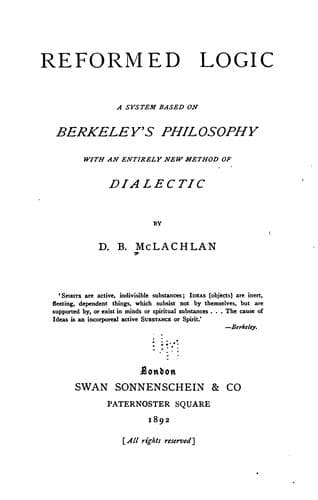
Reformed Logic: A System Based on Berkeley's Philosophy with an Entirely New Method of DialecticMcLachlan, D. B.
Philosophy
Reformed Logic: A System Based on Berkeley's Philosophy with an Entirely New Method of Dialectic
McLachlan, D. B.
Logic
The number of these moods is accidental, depending on flexibility
of language and ingenuity in inventing varieties of syntax. Mere
transposition of premises constitutes a difference of mood. Logicians
however pretend to base their numeration on a more general necessity.
They calculate from the distinctive parts of the three propositions
forming a syllogism, varied by negation, &c., that there _ought to be_
sixty-four moods. Experience proves that in spite of their free and
easy method of multiplying syllogistic varieties they cannot produce
anything like that number. One logician has thirty-six moods, another
thirty-two, a third eleven; the more orthodox fix the number at
nineteen. But they all admit that every argument can be reduced to
one of four fundamental types--the moods of the First Figure. Why then
have more classes than these four? Because, says Whately, it would be
'occasionally tedious' to reduce every argument to the first figure.
If the 11, 19, 32, or 36 classes were natural arguments taken
down untouched from men's lips, and it was found to be useless and
troublesome to reduce them to four artificial forms, the plea might
be admitted. But the so-called valid syllogisms are themselves
artificial, and just as tedious to make as the moods of the first
figure. Not only so, but an elaborate system of mnemonic rules is
provided for reducing the valid moods to the fundamental moods, thus
admitting that the former are only intermediate halting places between
the natural speech and the fundamental moods. It is _expected_ that
the intermediates should be reduced to the first figure.
Is there anything analogous to this sort of division in any science or
branch of practical thought? Would logicians themselves sanction such
a classification in a natural science? If a zoologist, for example,
were to determine beforehand how many classes of animals there
ought to be, would they not say he was acting improperly? If, after
discovering that he had five times as many classes as he could find
animals to put into them, he still retained his classification and
required his pupils to write out the names or symbols of all the
useless classes--would not logicians be apt to call him a pedant? Yet
in a modern work on logic such a task is prescribed for students:--
'Write out the sixty-four moods of the syllogism, _and strike
out the fifty-three invalid ones_.'
We might have excused the existence of a merely verbal classification
in logic, if it were accompanied by and subordinated to a
classification of theorems considered as mental facts. But in
syllogistic the verbal is the dominant classification, and we have
seen from the procedure of Sir William Hamilton--in dropping his
categorical judgments--that when the two principles of division
conflict, it is the mental which has to give way. The Letter is
allowed to kill the Spirit.
Public-domain text, read in full here on John Shaqi.
Reviews
Reviews
No reviews yet
Be the first to share your thoughts on this work.
Elsewhere in the archive
Join the Discussion
Join the discussion
Sign in to leave a comment or review.
Sign InorCreate an account