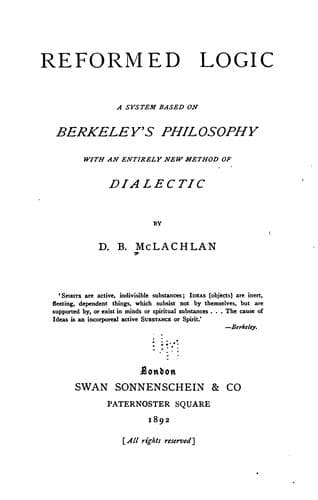
Reformed Logic: A System Based on Berkeley's Philosophy with an Entirely New Method of DialecticMcLachlan, D. B.
Philosophy
Reformed Logic: A System Based on Berkeley's Philosophy with an Entirely New Method of Dialectic
McLachlan, D. B.
Logic
In the remaining categories the reduction to 'is' has, if possible, a
worse effect. In changing 'Canada lies west of Ireland' into
'Canada is a country lying west of Ireland,' we lose the relation
in concretion, and express instead a verbal definition. Instead of
affirming a position we explain a name. In such a proposition as 'the
town of A lies 100 miles due north of B,' it is plain the predicate
cannot be a class, for only one place has the quality expressed.
In the fifth category we have such a proposition as 'water freezes
when the temperature falls to zero Centigrade.' This is turned into a
substantive sentence by saying 'water is that liquid which freezes,'
&c., which is a verbal or identical proposition.
'Cecrops founded Athens' is a judgment in causation. In turning it
into 'Cecrops was (or is) the founder of Athens,' we emphasise the
man's name, but the relation signified by 'founded' is slurred over
or lost sight of. Boole converts 'Caesar conquered the Gauls' into
'Caesar is he who conquered the Gauls,'[23] and this he interpreted
as classification. We need not be surprised that he should suppose
a class could be formed by one individual, for he elsewhere tells us
that _Nothing_ is a class.[24]
Classification is not judgment of any sort--it is a variety of
recollection. Logicians imagine it is the only judgment, and so far as
they can they degrade true judgments to that spurious form.
_Moods of the Syllogism._ Having persuaded themselves that
classification is the beginning, middle, and end of reasoning,
logicians next proceed to divide the matter of their science.
Modern logicians who have some acquaintance with real thinking as
exemplified in works of physical science, can, if acting according
to their natural intelligence, lay down correct rules for dividing a
subject. These are simple and obvious: divide according to fundamental
resemblance--let each division correspond to some definite human
utility--let the more important properties take precedence of the less
important, and so forth: the merest common sense.
But in the division of their own subject they follow Aristotle, and so
lose their way.
It is plain that an act of reasoning is a mental thing in the first
place, and only when uttered, and thus in a secondary sense, is it
a material object. The classification of arguments should therefore
follow mental characteristics. Logicians make it follow the material
characteristics of the terms in which the arguments are uttered. Their
moods of the syllogism are mere varieties of expression, not varieties
of reason.
Public-domain text, read in full here on John Shaqi.
Reviews
Reviews
No reviews yet
Be the first to share your thoughts on this work.
Elsewhere in the archive
Join the Discussion
Join the discussion
Sign in to leave a comment or review.
Sign InorCreate an account