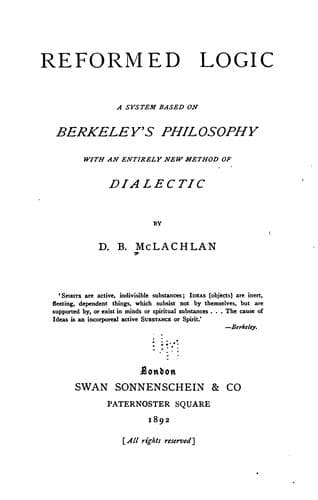
Reformed Logic: A System Based on Berkeley's Philosophy with an Entirely New Method of DialecticMcLachlan, D. B.
Philosophy
Reformed Logic: A System Based on Berkeley's Philosophy with an Entirely New Method of Dialectic
McLachlan, D. B.
Logic
'What remains of this massive erection [the Takht-i-Khosru,
or palace of Chosroës Anushirwan, at Ctesiphon] is a mere
fragment, which, _to judge from the other extant Sassanian
ruins_, cannot have formed so much as one fourth part of
the original edifice. Nothing has come down to our day but a
single vaulted hall on the grandest scale, together with the
mere outer wall of what no doubt constituted the main facade
of the building. The apartments, which, _according to all
analogy_, must have existed at the two sides, and in the rear,
of the great hall, some of which _should_ have been vaulted,
have wholly perished. _Imagination may supply_ them from the
Firuzabad, or the Mashita palace; but not a trace, even of
their foundations, is extant; and the details consequently are
uncertain, though the general plan can scarcely be doubted. At
each side of the great hall _were probably_ two lateral ones,
communicating with each other, and capable of being entered
either from the hall or from the outer air. Beyond the great
hall _was probably_ a domed chamber equalling it in width,
and opening upon a court, round which were a number of
moderate-sized apartments. The entire building _was no doubt_
an oblong square, of which the shorter sides seem to have
measured 370 feet. It had at least three, and _may not
improbably have had_ a larger number of entrances, since it
belongs to tranquil times and a secure locality.'
***
The most notable argument in the category of concretion is undoubtedly
the inference as to the sphericity of the earth. Next is the
sub-inference by Columbus that China could be reached by sailing
westward from Portugal. If the syllogistic opinion were valid--that a
conclusion must be absolutely true or absolutely false--the expedition
of Columbus was based on a fallacy. Most people think it was eminently
rational.
No one has seen the north or the south poles, and the conviction that
they could be realised, if certain difficulties of transport were
overcome, is a sub-inference of the same character.
Here is a common type of inference in perspection--
III.
That church | is 100 yards off
--------------------+----------------------
A man appears on | _he is_ 100 _ys. off_
the roof of the ch. |
And this--
III.
That distant house | is 60 ft. high
----------------------------+------------------------
It appears to be scaffolded | _the scaffold is about_
to a third of its height | 20 _feet high_
In these cases we have not seen the man or the scaffolding before,
and have not measured the latter or the distance to the former: the
conclusions are imaginary judgments fairly drawn from known premises.
***
Public-domain text, read in full here on John Shaqi.
Reviews
Reviews
No reviews yet
Be the first to share your thoughts on this work.
Elsewhere in the archive
Join the Discussion
Join the discussion
Sign in to leave a comment or review.
Sign InorCreate an account