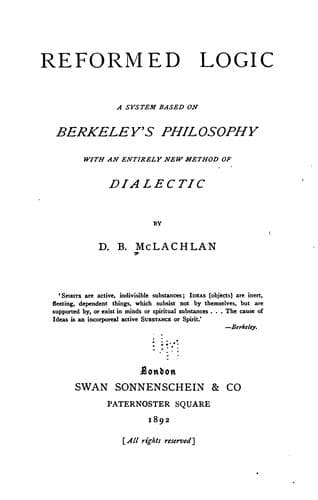
Reformed Logic: A System Based on Berkeley's Philosophy with an Entirely New Method of DialecticMcLachlan, D. B.
Philosophy
Reformed Logic: A System Based on Berkeley's Philosophy with an Entirely New Method of Dialectic
McLachlan, D. B.
Logic
I.
Whoever desires an effect | desires the cause of that effect
-------------------------------+---------------------------------
Everyone desires the happiness | _everyone desires virtue_
which is caused by virtue |
The case is manifestly untrue.
***
'He who has a confirmed habit of any kind of action exercises
no self-denial in the practice of that action; a good man
has a confirmed habit of virtue; therefore he who exercises
self-denial in the practice of virtue is not a good
man.'--(Arist. _Eth._ Bk. II., from Whately.)
VI. I.
He who has a | exercises no || He who exercises no | is good
habit, &c. | self-denial || self-denial in the |
| || practice of virtue |
------------------+--------------------++---------------------+--------
A good man has | _He exercises no || He who _does_ | _N. C._
this habit with | self-denial with || exercise &c. |
respect to virtue | respect to virtue_ || |
The conclusion drawn is fallacious, the second theorem being based on
contrast.
***
'According to theologians, a man must possess faith to be
acceptable to the Deity; now he who believes all the fables
of heathen mythology must possess faith; therefore such a one
must, according to theologians, be acceptable to the Deity.'
'Faith' is ambiguous, meaning in the precedent, spiritual aspiration,
and in the case ignorant credulity.
***
'No evil should be allowed that good may come of it; all punishment is
an evil; therefore no punishment should be allowed that good may come
of it.'--'Evil' is ambiguous, meaning wrong-doing in the precedent and
pain in the case; the conclusion is therefore fallacious.
***
'The principles of justice are variable; the appointments of
nature are invariable; therefore the principles of justice are no
appointments of nature.'--(Arist. _Eth._ Bk. V., from Whately.) The
terms 'principles of justice' and 'nature' require to be defined. It
might be said that justice is one principle, everywhere and always the
same, and that only its embodiments in law and custom are variable.
***
'What happens every day is not improbable; some things, against which
the chances are many thousands to one, happen every day; therefore
some things against which the chances are many thousands to one, are
not improbable.'--A fallacy of division: that improbable things in
general happen every day does not render the occurrence of any one a
probable event.
***
'Protection from punishment is plainly due to the innocent; therefore,
as you maintain that this person ought not to be punished, it
appears that you are convinced of his innocence.'--A fallacy of cross
reasoning.
Public-domain text, read in full here on John Shaqi.
Reviews
Reviews
No reviews yet
Be the first to share your thoughts on this work.
Elsewhere in the archive
Join the Discussion
Join the discussion
Sign in to leave a comment or review.
Sign InorCreate an account