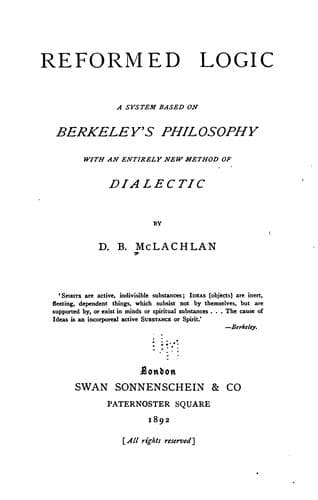
Reformed Logic: A System Based on Berkeley's Philosophy with an Entirely New Method of DialecticMcLachlan, D. B.
Philosophy
Reformed Logic: A System Based on Berkeley's Philosophy with an Entirely New Method of Dialectic
McLachlan, D. B.
Logic
'Whatever body is in motion must move either in the place where it
is, or in the place where it is not; neither of these is possible;
therefore there is no such thing as motion.'--It is an abuse of reason
to attempt to disprove matters of fact. The conclusion of an argument
being always problematical, it can have no force against actual
experience. We experience motion, therefore it cannot be disproved.
***
'A wise lawgiver must either recognise the rewards and punishments
of a future state, or he must be able to appeal to an extraordinary
Providence, dispensing them regularly in this life; Moses did not do
the former, therefore he must have done the latter'--(Warburton, from
Whately).--The reasoner omitted to establish that Moses was a wise
lawgiver, so that the precedent does not apply to his case, except by
courtesy.
***
'That man is independent of the caprices of fortune who places
his chief happiness in moral and intellectual excellence; a true
philosopher is independent of the caprices of fortune; therefore a
true philosopher is one who places his chief happiness in moral and
intellectual excellence.' An instance of cross reasoning.
I.
He who places | is independent
---------------------------+---------------
Philosopher is independent | _N. C._
***
'For those who are bent on cultivating their minds by diligent
study, the incitement of academical honours is unnecessary;
and for the idle it is ineffectual, for such are indifferent
to mental improvement; therefore the incitement of academical
honours is either unnecessary or ineffectual.'
A fallacy of doubtful precedent: because two kinds of students are not
benefited by the hope of honours it is prematurely concluded that no
others exist who may be so benefited.
***
'He who bears arms at the command of the magistrate does what
is lawful for a Christian; the Swiss in the French service,
and the British in the American service, bore arms at the
command of the magistrate; therefore they did what is lawful
for a Christian.'
The conclusion is valid so far as the information given enables us to
judge. If we know from other sources that the Swiss and British
who are referred to, committed atrocities at the command of the
magistrate, the conclusion is a fallacy of accident. In general it is
lawful to obey a magistrate, but there may be particular cases when it
is not.
***
'Anyone who is candid will refrain from condemning a book without
reading it; some reviewers do not refrain from this; therefore some
reviewers are not candid.'--This is cross reasoning and invalid. It
is one thing to say that the uncandid do not refrain, and another that
all who do not refrain are uncandid. The conclusion is taken from the
latter proposition, which is not asserted.
***
'Everyone desires happiness; virtue is happiness; therefore
everyone desires virtue.'
Public-domain text, read in full here on John Shaqi.
Reviews
Reviews
No reviews yet
Be the first to share your thoughts on this work.
Elsewhere in the archive
Join the Discussion
Join the discussion
Sign in to leave a comment or review.
Sign InorCreate an account