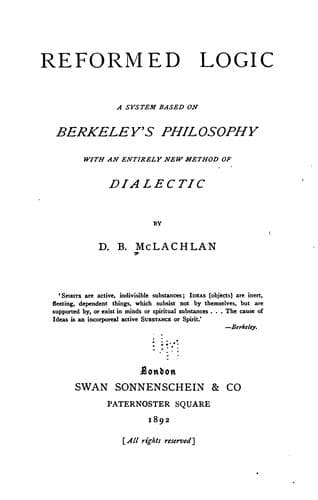
Reformed Logic: A System Based on Berkeley's Philosophy with an Entirely New Method of DialecticMcLachlan, D. B.
Philosophy
Reformed Logic: A System Based on Berkeley's Philosophy with an Entirely New Method of Dialectic
McLachlan, D. B.
Logic
VI.
To speak irrev. of Scr. in | indicates that a man is not
jest or earnest | wise or not good
---------------------------+------------------------------
This man does it | we must infer that _he is not
| w. or not g._
***
'If virtue were a habit worth acquiring, it must ensure either power,
or wealth, or honour, or pleasure; but virtue ensures none of
these; therefore virtue is not a habit worth attaining.' Fallacy of
contrast--
I.
What ensures | is worth
-------------------+---------
V. does not ensure | _N. C._
***
'If men are not likely to be influenced in the performance of a known
duty by taking an oath to perform it, the oaths commonly administered
are superfluous; if they are likely to be so influenced, everyone
should be made to take an oath to behave rightly throughout his
life; but one or other must be the case; _therefore_ either the oaths
commonly administered are superfluous, or everyone should be made to
take an oath to behave rightly throughout his life.'--This will be
more intelligible if contracted thus: If oaths fail to influence they
are superfluous; if they influence they should be obligatory; but they
either influence or do not; therefore they are either superfluous
or should be obligatory. There is no argument; the alternative
conclusions merely repeat the alternative precedents.
***
'If virtue is voluntary, vice is voluntary; but virtue is voluntary;
therefore so is vice.' (Arist. _Eth._ Bk. III. quoted by Whately.)
This is a circular way of saying that we believe it to be a fact that
vice is voluntary. The argumentative form is probably supposed to
give the assertion greater weight than it would have if expressed as a
perceptual judgment.
***
This is valid argument, according to Hamilton--'If man were suited to
live out of society, he would either be a god or a beast; but man is
neither a god nor a beast; therefore he is not suited to live out of
society.'--It has faults of contrast and tautology.
I.
Only gods and beasts | are suited
-------------------------+-----------
Man is neither g. nor b. | _N. C._
***
'If iron is impure, it is brittle; but this iron is impure; therefore
it is brittle.'--A valid dogmatic argument.
I.
Impure iron | is brittle
------------------+-----------------
This iron is imp. | _it must be br._
***
'If the weather is fine, we shall go into the country; now the weather
is fine, therefore we shall go into the country.'--We never get beyond
the simple judgment that our going into the country is associated with
fine weather.
***
The following is valid:--'As often as the weather is fine, my
brother has a habit of going into the country; if the weather be fine
to-morrow I infer that he will go into the country.' Here a particular
hypothetical case is illustrated by reference to a general habit.
Public-domain text, read in full here on John Shaqi.
Reviews
Reviews
No reviews yet
Be the first to share your thoughts on this work.
Elsewhere in the archive
Join the Discussion
Join the discussion
Sign in to leave a comment or review.
Sign InorCreate an account