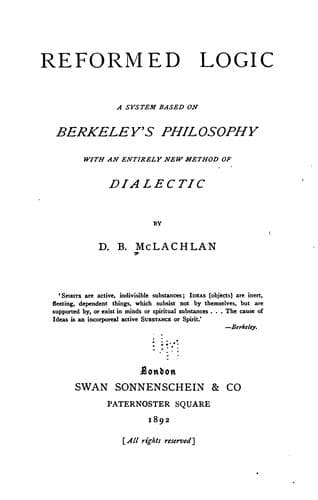
Reformed Logic: A System Based on Berkeley's Philosophy with an Entirely New Method of DialecticMcLachlan, D. B.
Philosophy
Reformed Logic: A System Based on Berkeley's Philosophy with an Entirely New Method of Dialectic
McLachlan, D. B.
Logic
'Something has existed from eternity. For since something now
is, it is manifest that something always was. Otherwise the
things that now are must have risen out of nothing, absolutely
and without cause. Which is a plain contradiction in terms.
For to say a thing is produced, and yet that there is no
cause at all of that production, is to say that something is
effected when it is effected by nothing, that is, at the same
time when it is not effected at all. Whatever exists has a
cause of its existence, either in the necessity of its own
nature, and then it must have been of itself eternal: or in
the will of some other being, and then that other being must,
at least in the order of nature and causality, have existed
before it.'
In this theorem we have a case--'Something is'; and a
conclusion--'Something has existed from eternity.' The reasoner
seeks a credible or conceivable precedent by which to connect that
conclusion with the case.
We are offered a choice of two theorems. The first is untenable, for
we have never had the experience that is given as precedent; it is
also tautological, as the 'something' of the case is the 'whatever' of
the precedent.
V.
Whatever exists in the necessity | has existed from eternity
of its own nature |
------------------------------------+-------------------------------
'Something' exists in the necessity | _it has existed from eternity_
of its own nature
It is not inconceivable that something should be self-existent, but we
know nothing as to its being eternal. We are not familiar enough with
self-existent things and eternal things to warrant us in asserting
dogmatically that where the first quality is, there also must be the
second.
The next theorem is that everything must be caused, and that causation
involves a _regressum ad infinitum_. On this principle there must
have been things for an eternity backwards. According to the theory of
causation given in section XXVII, a true beginning is reached when we
discover the motive, design and power that produced an effect. It is
not necessary to ask next what caused that motive, design and power.
The infinite regress is applicable only to _material sequence_, in
which there is no proper beginning or end. The author of the above
argument seems to be trying to combine the notion of causation by
_will_ with that of infinite regress. But his language is too obscure
to make it certain what he means exactly.
***
The three following theorems--in a diluted form--occur in an otherwise
excellent work on the politics and social life of the ancient Greeks.
Public-domain text, read in full here on John Shaqi.
Reviews
Reviews
No reviews yet
Be the first to share your thoughts on this work.
Elsewhere in the archive
Join the Discussion
Join the discussion
Sign in to leave a comment or review.
Sign InorCreate an account