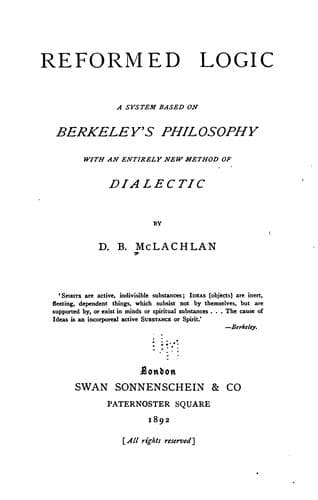
Reformed Logic: A System Based on Berkeley's Philosophy with an Entirely New Method of DialecticMcLachlan, D. B.
Philosophy
Reformed Logic: A System Based on Berkeley's Philosophy with an Entirely New Method of Dialectic
McLachlan, D. B.
Logic
There are other things in the photographic art remarkably similar to
intellectual thinking. The gelatine film behaves very like the mental
plasma: only one other physical object (so far as I am aware) is a
better image of the plasm.
In theory the object or phenomenon has no importance. Even when it
has the quality we call 'beauty,' that is not a property of the
bare object, for it is not seen by every person or animal with good
eyesight; it is a sentimental effect associated with the object. Hence
we might, if it were possible, ignore all objects except those which
have value to us as signs of sentimental effects.
But in practice we cannot do this. Objects are thrust upon our notice
which we cannot avoid, and which have no sentimental interest for us.
These objects are necessarily classified according to their phenomenal
appearance only, and such ideas lack an essential characteristic of
true general ideas. But we cannot prevent their formation in the
mind, for generalisation is merely a kind of abbreviated memory, and,
objects being once perceived, their recollection is to a great extent
beyond our control.
Artificial and adventitious utilities produce the same kind of
one-sided generalisation. If society pays a man in fame or money to
observe and describe certain things, his classification of them will
be purely phenomenal. He will classify dogs with wolves and nightshade
with potato, and will lump together the whole population of a country
in one class, although it consists of the most divers elements--fools
and philosophers, rogues and righteous, saints and sinners, patricians
and plebeians. These are differences much more important than sameness
of nationality, colour, race, or language.
This practice, no doubt, gives symmetrical classifications. The
greater classes are subdivided into subordinate classes, and these
again into lower classes in a many-stepped series. Gradation occurs
also in true generalisation, but not to the same extent.
If we confine our observation to things that are much like each other,
the average idea will not be greatly different from a particular idea:
this is called _lowness_ in generality. If we run together quadrupeds,
bipeds and fishes, we shall have a much higher general idea: the
average will be very unlike any concrete animal. The higher we
generalise the smaller becomes the content of the idea, but the wider
its extension, that is, the realm of objects from which it has been
drawn, or which it is considered to represent. The usual practice is
to generalise by fine gradations. Get the general idea of sheep, then
of cow, then of horse; then average the averages. The result is much
the same if we run all the objects together and average them in
one operation, but the slower process gives the neater results. The
gradations of generality are distinguished by names such as (beginning
from below) variety, species, genus, class, family, kingdom.
Public-domain text, read in full here on John Shaqi.
Reviews
Reviews
No reviews yet
Be the first to share your thoughts on this work.
Join the Discussion
Join the discussion
Sign in to leave a comment or review.
Sign InorCreate an account