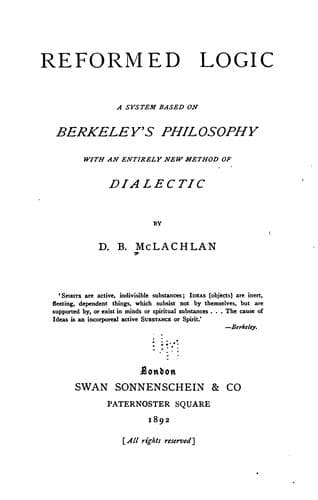
Reformed Logic: A System Based on Berkeley's Philosophy with an Entirely New Method of DialecticMcLachlan, D. B.
Philosophy
Reformed Logic: A System Based on Berkeley's Philosophy with an Entirely New Method of Dialectic
McLachlan, D. B.
Logic
The imaginary interval we place between objects of different
perspective effacement, can be expressed in terms of exact lateral
measurement. This is done by developing and measuring the associative
groups represented in the perspective group. Supposing we wish to
get an exact definition of the perspective condition of a mountain
relative to a certain station, we can, from that station, develop
all the natural groups up to the mountain (walk over the ground)
and measure the lateral intervals and masses disclosed. The total
measurements will be a definition of the mountain's perspective
distance in terms of true associative distance. That is what we mean
by saying a mountain is ten miles off. It is not _really_ ten miles
off--it is not an inch off. But to render it tactually perfect we
should have to expend an amount of energy equal to 17,600 times the
energy required to move from one associative object to another a
yard apart from it laterally. If we practise the mileage scale in
conjunction with the perspective indications, we may acquire the art
of expressing in miles, though not measured, the distance of objects
estimated from purely perspective data, but few can do this with any
near approach to exactness[14].
The realistic three-dimensioned space is a combination of the true
interval of association and the false interval of perspection. This
generates an idea resembling the capacity or vacancy in a room
or vessel, and thus it is supposed that objects occupy a sort of
universal room without walls, floor, or ceiling. It is however the
enclosing objects which make a room, and when they are abstracted
there remains nothing. The universal room is therefore nothing--a
myth. It is a useful working theory for common purposes, but in
philosophy it is superfluous and obstructive.
In the definitions of geometry no difference is made between the depth
of a landscape and the 'third dimension' of any small cubic object.
They are both called 'third dimension' or 'cubic dimension.' Yet
they are inferences of different categories, and neither is real.
The former, as we have just seen, is the imagined redintegration of
objects perspectively shrunk and defaced. The latter is the imaginary
completion of a thing having many surfaces or facets, only one of
which can be shown at a time.
_Sky Perspection._ The effect produced on our mind by the observation
of celestial objects, reveals at once the artificiality of cubic
space. Clouds in their form and movements are somewhat like earthly
things--vapour or mountains,--and so we conceive them partially
graduated in distance and floating in a concavity. But whether they
are a mile off, or twenty miles off, few of us can tell.
Public-domain text, read in full here on John Shaqi.
Reviews
Reviews
No reviews yet
Be the first to share your thoughts on this work.
Join the Discussion
Join the discussion
Sign in to leave a comment or review.
Sign InorCreate an account