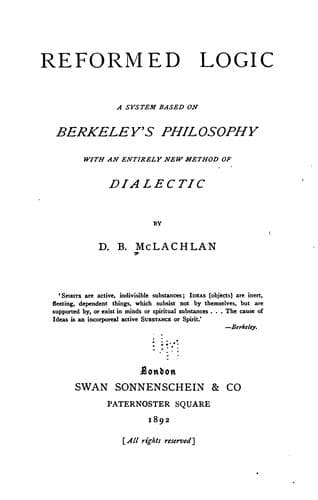
Reformed Logic: A System Based on Berkeley's Philosophy with an Entirely New Method of DialecticMcLachlan, D. B.
Philosophy
Reformed Logic: A System Based on Berkeley's Philosophy with an Entirely New Method of Dialectic
McLachlan, D. B.
Logic
When we contemplate the sun, moon and stars, our realism is completely
at fault. These we cannot modify at will, and they move too slowly and
present too uniform an aspect to cause the perspective effect. Since
we have never seen them at the tactual range we know not to what
degree they are perspectively incomplete; hence they appear without
relative distance--distance being simply a metaphor of perspective
effacement. If 'cubic space' is real, let the realists tell us why we
do not see it in the sky--why we do not arrange the stars behind
each other according to their calculated distances. This question
is unanswerable realistically, but idealistically it presents no
difficulty. The sky is not spaced, because the conditions are wanting
under which the illusion of terrestrial space is formed in the
intellect.
By close instrumental attention to the moon and planets a slight
parallax is observable, and on the analogy of terrestrial parallax
astronomers are able to calculate what they call the distance of these
bodies. Perhaps their calculations are right, but the magnitudes are
not conceivable as associative distance, being so much greater than we
have any experience of. We take them to mean that the heavenly bodies
are extremely degraded, perspectively speaking. Their noumena are in
contact with our minds, for this is essential to perception, but
if astronomical calculations are correct the contact is infinitely
slight, compared with what it would be, supposing--to speak
realistically--we could go to the stars or they could be brought to
us.
Berkeley's _Theory of Vision_ and _Dialogues_ are occupied with the
analysis of perspection. The arguments he uses to show that distance
outwards is not real are in the main those given in this section.
XXV--CONCRETION
If we take a cricket-ball in the hand and turn it round we shall
perceive a series of discs. Only one of these can be seen at a time,
but if we perceive and remember the whole series we shall be able to
infer all from the perception of one in a similar object. The same
occurs with other cubical or solid objects. This is a form of ideal
construction different from any we have yet considered. It differs
from inherence in that the object which we conceptually put together
is never objectively perceived as a whole. It is an imaginary whole
constructed in the intellect out of fragmentary experience. It differs
from association on the same grounds; the latter can be all perceived
at once in forming the judgment. It differs from perspection in that
the imperfection of experience is due to curtailment, not to general
deterioration. What we actually see may be perspectively perfect. It
differs also from the next category in that the series of perceptions
can occur in various orders of succession.
Public-domain text, read in full here on John Shaqi.
Reviews
Reviews
No reviews yet
Be the first to share your thoughts on this work.
Join the Discussion
Join the discussion
Sign in to leave a comment or review.
Sign InorCreate an account