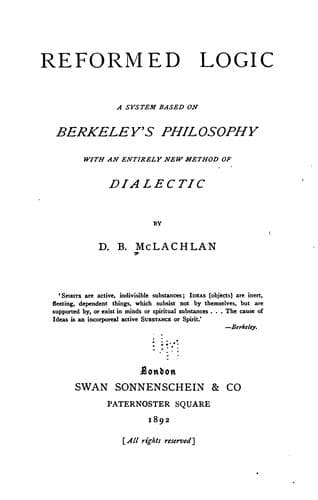
Reformed Logic: A System Based on Berkeley's Philosophy with an Entirely New Method of DialecticMcLachlan, D. B.
Philosophy
Reformed Logic: A System Based on Berkeley's Philosophy with an Entirely New Method of Dialectic
McLachlan, D. B.
Logic
_The 'backs' of Things._ We talk of the back of a thing, but nobody
has ever seen a back. Things have no backs in the popular sense of the
word. When we turn round a back to perceive it, it is then a front.
Everything is a flat upright surface, and its appearance of solidity
can be imitated on a surface known to be flat, and with nearly the
same illusive completeness as in the original object. In turning
things round we merely change the surface; we are exercising our power
to alter primary consciousness.
When two persons perceive the 'same' object from contrary directions,
the sameness means that the two objects proceed from the same cause,
or can be reduced to the same general idea. But the objects are
numerically distinct. By a similar turn of speech we say that A
and _a_ are the same _letter_, but they are evidently distinct and
dissimilar objects. If we hold a thing before a mirror and see what is
termed its back, we produce a new object resembling the first in some
respects but without its resistance.
Resistance is a negative term signifying the limit of our power to
alter primary experience. Where our power ceases resistance is said to
begin, and we meet with resistance when we apply a power inadequate to
the desired effect.
Dr. Johnson's solitary experiment in idealistic philosophy has been
often related. He struck a post, and because it did not disappear he
thought he had disproved Berkeley's statement that material objects
exist only in the perceiving mind. The experiment merely showed that
all means are not adequate to change all primary experience. Had he
shut his eyes, or turned a corner, or occupied his attention with
other matters, the post would have vanished. He chose improper means
and therefore met with 'resistance.' No idealist believes we can
change our primary experience by any capricious and frivolous
means[15].
_Geographical Concretion._ The knowledge of large geographical areas
is an artificial construction without objective reality.
Public-domain text, read in full here on John Shaqi.
Reviews
Reviews
No reviews yet
Be the first to share your thoughts on this work.
Join the Discussion
Join the discussion
Sign in to leave a comment or review.
Sign InorCreate an account