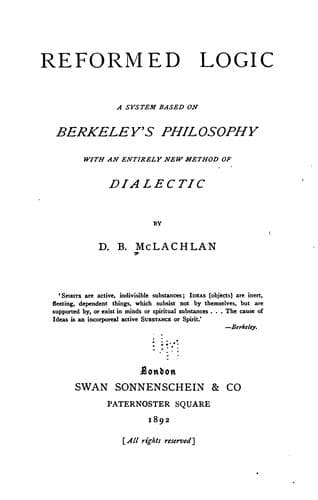
Reformed Logic: A System Based on Berkeley's Philosophy with an Entirely New Method of DialecticMcLachlan, D. B.
Philosophy
Reformed Logic: A System Based on Berkeley's Philosophy with an Entirely New Method of Dialectic
McLachlan, D. B.
Logic
Our experience is, literally and exactly, a series or sequence--a flux
or stream. It is composed of objects or of groups, according to the
width of our attention. If we travel over a large tract of country
the experience is a train of objects or views, which follow each other
continuously but for interruptions in attention. If we were bound to
think of things in the order in which they were experienced, we should
have to imagine our topographical consciousness as a long ribbon of
views, like the pictures of a panorama. Supposing we travelled hither
and thither over one county, it would appear to us as a straight
strip of land which might be several hundred miles long. If we again
traversed the ground, but in another order, we should have another
strip resembling the first, but also differing from it, and it would
be necessary to keep the two from being confused in our mind. If
several persons traversed the same ground but in divers directions,
they would each retain a different recollection of it, and it would
be extremely hard for any two of them to agree as to the order in
succession of any portion of the ground traversed.
Our experience of the natural group suggests a mode of treating our
geographical experience which overcomes many of these inconveniences.
We find that we can traverse (either bodily or by the eye) a single
landscape in a thousand directions, and retain a memory of it without
any reference to these directions. What we remember is the mutual
positions of the objects, not the order in which they were observed.
As this greatly facilitates the memory of one group, we apply the
same principle of synthesis to the succession of groups composing
our geographical experience. We dismiss from our minds the order of
observation, and construct instead an imaginary group of associated
objects or places having mutual positions. It is imaginary, for no one
has ever seen as a co-existent synthesis the objects of a county,
not to speak of a country or continent. Substituting for memory of
succession, a memory of position, there grows up in our mind a large
co-existent image of a country on the model of a single group, which
affords all the advantages as regards economy of energy which we
enjoy by virtue of comprehending a natural group in one act of
consciousness.
Public-domain text, read in full here on John Shaqi.
Reviews
Reviews
No reviews yet
Be the first to share your thoughts on this work.
Elsewhere in the archive
Join the Discussion
Join the discussion
Sign in to leave a comment or review.
Sign InorCreate an account