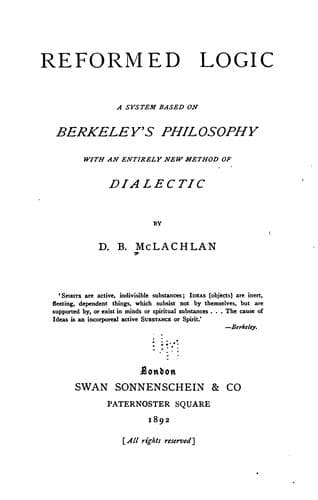
Reformed Logic: A System Based on Berkeley's Philosophy with an Entirely New Method of DialecticMcLachlan, D. B.
Philosophy
Reformed Logic: A System Based on Berkeley's Philosophy with an Entirely New Method of Dialectic
McLachlan, D. B.
Logic
Take an instance of this economy. Suppose a man travelled from London
to Oxford, then to Exeter, then to Portsmouth, then to Brighton, and
afterwards desired to return to London. If he, acting on a mistaken
conception of truth and disdaining instruction from others, persisted
in remembering the objects perceived on his journey as--what they
no doubt literally were--a continuous series, he would be unable to
imagine any way of returning to London except by reversing the order
of his journey. If on the other hand he carried in his mind an image
of the ground in question, with the mutual position of the places,
it would enable him to _foresee_ that London was to be reached by
journeying northward from Brighton, in far less time and at far less
cost than by returning the way he came. Thus does conceptual position,
when it is correctly imagined, prove its superiority to the order of
experience. And we say that the ideal picture is truer than the crude
memory,--not that it is really so if natural order is a test of truth,
but because it is the least onerous, which is our practical standard
of truth. The only object of knowledge being the wise management of
energy, that sort of knowledge must be considered truest that enables
us to have the feelings we desire at the least cost. In one sense
truth means the quickest and easiest way of passing from one state of
consciousness to another preconceived state.
It may be objected to the above example as a valid deduction from an
imaginary synthesis, that the relation of London to Brighton is now a
certainty, whereas an inference can be no more than a probability. The
reply is, that if a man has already traversed the route in question,
it is to him an actual experience and his idea of it is ever
afterwards a memory, not an inference. But until it is actually
perceived it must be imaginary, and therefore slightly problematical.
Although a man is convinced that others are not deceiving him in
saying a place is to be reached in a certain way, he cannot be
absolutely sure that he fully understands the directions given,
in other words, that his image of the route corresponds to their
perception of it. There probably never is exact similarity between one
man's primary experience and another man's idea of it. It may even
be doubted whether there is ever exact similarity between a man's own
primary experience and his subsequent idea of it.
The geographical synthesis is founded on actual exploration
supplemented by inference. The mutual position of some important
places are determined and serve as precedents for a multitude of minor
positional deductions. _A_ is twenty miles north of London, _B_ is
ten miles south of London, hence _A_ is thirty miles north of _B_.
The mileage is determined by imagining the synthesis developed into
natural groups and measured laterally. Other scales are the time
spent in travelling between the places, or the money it costs, or the
distance delineated on a map.
Public-domain text, read in full here on John Shaqi.
Reviews
Reviews
No reviews yet
Be the first to share your thoughts on this work.
Elsewhere in the archive
Join the Discussion
Join the discussion
Sign in to leave a comment or review.
Sign InorCreate an account