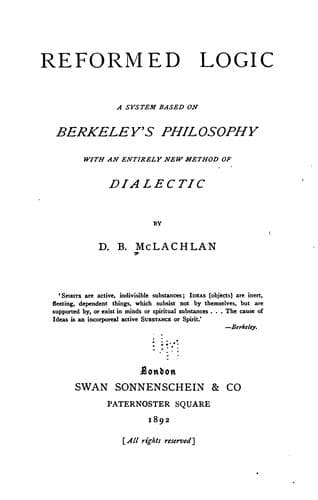
Reformed Logic: A System Based on Berkeley's Philosophy with an Entirely New Method of DialecticMcLachlan, D. B.
Philosophy
Reformed Logic: A System Based on Berkeley's Philosophy with an Entirely New Method of Dialectic
McLachlan, D. B.
Logic
Though the geographical concretion may be modelled on the association,
we cannot treat it perspectively, for the places being purely
ideal (except the one we are at), the ideal image is not liable to
deterioration by weakened perception. It may suffer degradation by
forgetfulness, but that has nothing to do with perspection.
_Sphericity of the Earth._ The geographical synthesis is not always
formed on the pattern of a natural association. That is the first and
most obvious shape to give it, and for thousands of years it
appears to have answered the topographical needs of mankind. But as
exploration extended it was found that the associative theory did not
in some cases afford true preconception. If we travel far enough
in any fixed direction we shall return to the point from which we
started. This could not have been predicted from a synthesis formed
on the model of a landscape. Such a return however takes place in the
objects denominated spheres, and so the spherical instead of the flat
form has been conceptually given to the geographical concretion. That
is all that is meant by saying that the world is round. There is
no world, as the mystical realist--projecting outwards his mental
synthesis--imagines. There is only a scheme of spherical positions
in the intellect, which facilitates the recollection of places and
enables us to foresee the shortest and easiest way of reaching--_i.e._
experiencing places. The concretion is true inasmuch as the prediction
is found to coincide with real experience. But that by no means
implies that the places exist except when perceived in minds.
XXVI--SEQUENCE
Sequence is a series most resembling a procession of objects in a
natural group (second category). It differs therefrom in that the
objects cannot be seen together. It differs from concretion in that
the order in which the objects appear cannot be altered, or if they
are human and alterable we cease to treat them as a sequence. They
no longer have the predictive value which moves us to form artificial
groups of objects.
Satisfactory examples of reasoning in sequence are less numerous than
might be supposed. It is a poor category for argument. Series either
occur with perfect regularity, like the seasons of the year, phases
of the moon, &c., and then they rapidly become mere recollections and
lose the problematical character essential to a true inference, or
the connection between the objects is too casual for argumentative
purposes. Darwin's theory of the formation of coral atolls is a fine
argument in sequence, but the application of this theory to reefs not
examined by him is hardly uncertain enough to be an argument. It is
the first sequential inference that is valid--the rest are foregone
conclusions.
Public-domain text, read in full here on John Shaqi.
Reviews
Reviews
No reviews yet
Be the first to share your thoughts on this work.
Elsewhere in the archive
Join the Discussion
Join the discussion
Sign in to leave a comment or review.
Sign InorCreate an account