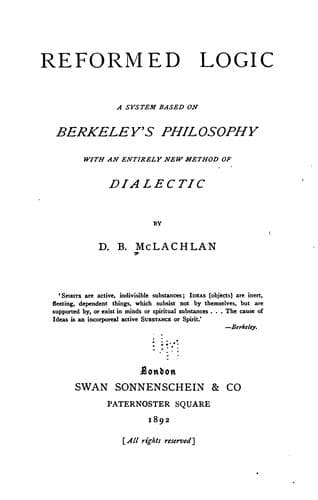
Reformed Logic: A System Based on Berkeley's Philosophy with an Entirely New Method of DialecticMcLachlan, D. B.
Philosophy
Reformed Logic: A System Based on Berkeley's Philosophy with an Entirely New Method of Dialectic
McLachlan, D. B.
Logic
Geology supplies some good sequences. It has been noticed, for
instance, that the sea leaves ripple-marks on sandy beaches, and
stones with similar marks have been found at a distance from the sea;
it is a valid sequential inference that the marks in the latter case
have also been formed by the action of the waves. Here the difference
in locality between the two compared series--the modern complete
and the ancient incomplete--supplies that slight element of doubt
essential to an argument.
So as regards the mode of making ancient flint tools: it has been
found that tools exactly similar to the ancient can now be made with
the simplest possible means, and it is a true argument to infer that
the ancient implements were made by these means. The conclusion is
highly probable without being infallibly certain, and that is what a
dialectical conclusion ought to be.
We may admit that some of the astronomical sequences are forms of
reasoning, for they were such to their first discoverers, and to minds
not thoroughly conversant with them they are still in the nature of
predictions that might fail of accomplishment. Political, financial,
and sporting forecasts are sequential arguments, and we may also
include speculations on the future states of all growing organisms and
developing institutions.
_Time._ The intervals between the objects of a sequence are imagined
after the model of lateral intervals in association. This is Time.
Like space it is mere blanks in experience, though treated by realists
as external and self-subsisting. It can be measured by reference to
objects on whose sequential recurrence we have the most reliance, such
as the phases of the moon, the positions of the sun in the ecliptic,
the movements of the hands of a clock or the chiming of its bells.
Abstract or unbounded time is called 'eternity'; like abstract space
it is a refined form of nothing. Time and space are usually coupled
together as if co-ordinate, but eternity is the co-ordinate of space.
Time is divided sequence and would correspond to materially divided
space, that is, space with objects in it at regular intervals.
Matter, space, and time are the three pillars of the realistic world.
We have now seen what they are made of. Matter is a general idea
compiled by ourselves from phenomenal consciousness. It is no
substance--only an average. Space has even less reality. It is first
the interval between two objects in association; then this interval
is used metaphorically as an expression and measure of perspective
decadence. Time is an application of the same associative interval
to express the blanks between objects in sequence. Space and time
are thus pure nullities--negatives with positive names. These three
notions being exploded as entities, there remain as a residuum of true
fact and the starting-point of philosophy--_minds_, their _energies_,
and their _consciousness_. This is a very ancient triad.
Public-domain text, read in full here on John Shaqi.
Reviews
Reviews
No reviews yet
Be the first to share your thoughts on this work.
Elsewhere in the archive
Join the Discussion
Join the discussion
Sign in to leave a comment or review.
Sign InorCreate an account