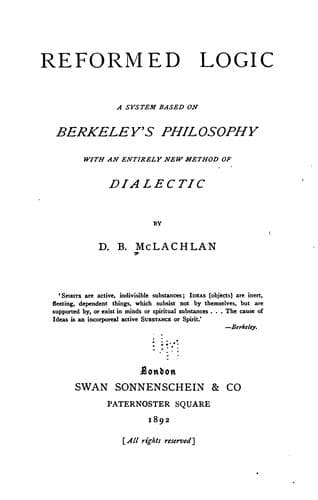
Reformed Logic: A System Based on Berkeley's Philosophy with an Entirely New Method of DialecticMcLachlan, D. B.
Philosophy
Reformed Logic: A System Based on Berkeley's Philosophy with an Entirely New Method of Dialectic
McLachlan, D. B.
Logic
Science constantly confounds sequence and causation. We are told that
the moon _causes_ eclipses of the sun, that heat _causes_ objects to
expand, that a seal _causes_ an imprint. This is a metaphor from human
causation, and the expression is now so rooted in language that it
would hardly be possible to introduce a more correct phraseology. Yet
it is as incorrect as to say that one o'clock causes two o'clock, or
that daylight causes darkness. The confusion has arisen from the fact
that both sequence and causation deal with fixed inconvertible series,
but only in the latter is there real power exerted to produce the
effect. Material things and their apparent effects are due to a cause
lying behind both.
XXVII--CAUSATION
Causation differs from all other categories in that one of its
elements is mental. It is a series beginning in the mind--in this
relation denominated _cause_--and developing into objective phenomena
called _effects_ or an effect. The series being known by judgment
we can infer similar causes from perception of similar effects. The
commonest causation is the use and interpretation of language. Because
we utter words from a certain motive we infer that all who utter
the same words do so from the same motive. That is the reason of the
intelligibility of words.
This category is peculiar from the extremely narrow range of the
experience which supplies the judgments. We never perceive any mind
but one--our own--and this has to supply all the judgments by which we
reason concerning other minds. There is therefore no category in which
correct reasoning is so difficult and so rare. No amount of experience
entirely overcomes this defect, for if we are ignorant we cannot
understand the wise, and if we are wise we cannot conceive the motives
of the ignorant and vicious. Only those persons who are mentally very
like each other are mutually comprehensible.
This category has a further peculiarity. In all the rest the inference
relates to objective experience, and this being due to interaction of
minds we are justified in saying that until it is perceived it has no
existence. But in causation we are inferring something with reference
to a mind, and this exists though we never can perceive it. We know
that minds exist without perception because we know that our own
exists though no one perceives us--though we are in total darkness and
silence and cannot ourselves perceive our bodies. As already stated,
Existence has not the same meaning when applied to objects and
to minds, objects being merely temporary conditions of minds. The
non-existence of inferred but unperceived objects does not follow from
any defect in the faculty of inference, but depends on the essential
character of objects. They are created by mutual contact of minds
and cannot exist without that condition, however clearly they may be
inferred and however correctly their appearance may be predicted.
Public-domain text, read in full here on John Shaqi.
Reviews
Reviews
No reviews yet
Be the first to share your thoughts on this work.
Elsewhere in the archive
Join the Discussion
Join the discussion
Sign in to leave a comment or review.
Sign InorCreate an account