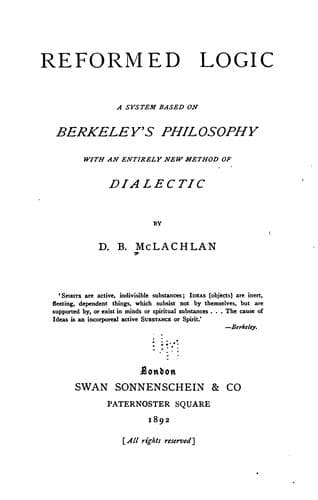
Reformed Logic: A System Based on Berkeley's Philosophy with an Entirely New Method of DialecticMcLachlan, D. B.
Philosophy
Reformed Logic: A System Based on Berkeley's Philosophy with an Entirely New Method of Dialectic
McLachlan, D. B.
Logic
Causation is confounded with sequence because both are series. Let
me illustrate the difference between them by an example. I turn the
stop-cock of a pipe, and water flows from the open end of the pipe.
In popular and even scientific language it would be said that I caused
the water to flow. But this is incorrect. All I caused was the turning
of the tap; that alone was wholly due to my energy and intelligence.
There followed as a sequence the outflow of water, but that was due
partly to cosmic force and partly to the previous human causation (not
mine) implied in making and laying down the pipe so as to utilise the
cosmic force. I merely removed an obstacle that prevented the further
development of the force in a particular direction. My relation to the
outflow was sequence, not causation.
In observation sequence registers fixed or probable series of
_objects_ without regard to their causes. It is sufficient if they
occur regularly enough to justify prediction. Causation, on the other
hand, pays no regard to physical connection of any sort, but seeks
out the being or beings who supplied the energy producing an effect or
series of effects. The speculations in causation pass quite beyond the
domain of objectivity, over into the realm of true creation.
When we read that 'the succession of events is an endless chain of
effects which are in their turn causes of new effects,' what is meant
is sequence, and for 'cause' and 'effect' the terms 'antecedent' and
'consequent' should have been employed. Sequences may be 'chains' and
may be long, but if so their links have been forged by independent
causes acting _across_ the chain; as when a line of soldiers fire
in succession at regular intervals, or as in the case of the moon's
quarters. In these instances the objects, although forming a series,
has each a cause of its own.
Certainly a causation is a series, for the cause precedes the effect.
But an effect is never the cause of a succeeding effect. When this
appears to be the case the explanation is that the energy was not
exhausted in producing the immediate simple effect, but has produced
a complicated effect in which a series may be discovered. An
objective effect, being a mere flash of consciousness--a shadow on a
window-blind--is incapable of causing anything.
_Analysis of Cause._ Cause is mind in action. It consists of at
least energy and a sentimental _motive_--energy exerted to gratify
sentiment. If the mind is intellectualised there will probably be
an ideal element in the cause--in this connection called _plan_
or _design_--for the better direction of the energy. Normal human
causation consists of an effort of mind directed towards the objective
realisation of a plan, for the gratification of a sentiment. This is
the same as WILL.
Public-domain text, read in full here on John Shaqi.
Reviews
Reviews
No reviews yet
Be the first to share your thoughts on this work.
Elsewhere in the archive
Join the Discussion
Join the discussion
Sign in to leave a comment or review.
Sign InorCreate an account