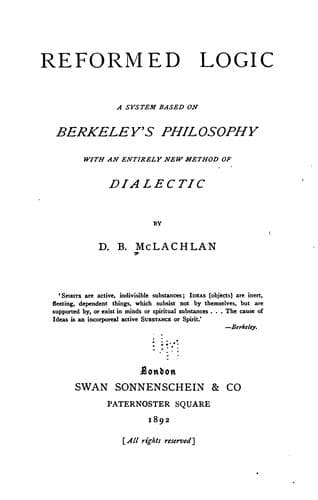
Reformed Logic: A System Based on Berkeley's Philosophy with an Entirely New Method of DialecticMcLachlan, D. B.
Philosophy
Reformed Logic: A System Based on Berkeley's Philosophy with an Entirely New Method of Dialectic
McLachlan, D. B.
Logic
All three elements of cause may be furnished by the same
individual--or any two of them--or only one. For instance, the man who
wants a house supplies the motive, the architect provides the design,
the builder finds the energy.
One plan may use up an indefinite number of separate stores of energy.
Even in an individual the realisation of a plan exhausts the powers
of millions of organic cells. A military campaign illustrates the
relation of plan to power. The design may have been formed by one man,
and then communicated wholly or partially to a hundred thousand, and
the energies of these may be devoted to its realisation. The soldier
fights with his own energy, but he is directed by his commander's
idea, or so much of it as has been confided to him. The design may
stretch from the commander to the soldier, but not the energy. In
order that the commander should be termed the 'cause' of his private's
activity, it would be necessary to eliminate the notion of exerted
energy from causation, and reduce it to bare communication of design,
which would be absurd.
The stretching of one design over many relays of energy has no
doubt helped to confirm the notion that causation is a long chain of
alternate causes and effects. The truth is that energy can act only
at short range, and has to be incessantly renewed. The world is in a
constant state of creation and dissolution, say the Kabbalists. It is
absurd to speak of anything that existed a thousand or even a hundred
years ago as the _cause_ of anything existing to-day. The design may
intellectually survive, but the energy is long since dissipated. We
have never more than about a day's supply of energy in store at once.
If sentiment, power, and design are supplied by different individuals,
no single one of them can be called the cause of the effect. The
relation of each to the result is sequence. When we have traced
an effect to the mind or minds that supplied the three or the two
necessary elements--supposing the design is sometimes omitted and
the act what we call _instinctive_--we have obtained a complete
explanation of the effect. Our curiosity is then absolutely satisfied.
We have reached a true beginning.
It is the want of this thorough explanation that renders material
science so disappointing. We are put off with a mere physical
antecedent, which itself needs explanation as much as its consequent.
It does not make the antecedent more significant to place it far back
in time, for time by itself is not a cause--it is merely a name given
to intervals of experience. A thing is never truly explained until we
see that its production either caused pleasure to something else, or
was expected to cause pleasure. Behind everything must be Sentiment.
Public-domain text, read in full here on John Shaqi.
Reviews
Reviews
No reviews yet
Be the first to share your thoughts on this work.
Elsewhere in the archive
Join the Discussion
Join the discussion
Sign in to leave a comment or review.
Sign InorCreate an account