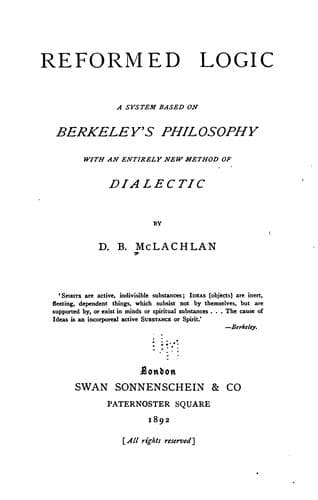
Reformed Logic: A System Based on Berkeley's Philosophy with an Entirely New Method of DialecticMcLachlan, D. B.
Philosophy
Reformed Logic: A System Based on Berkeley's Philosophy with an Entirely New Method of Dialectic
McLachlan, D. B.
Logic
In the 'gamut' the effects are in sequence, but they have all the same
physical antecedent.
_e_^1 _e_^2 _e_^3 _e_^4 _e_^5
| | | | |
+------+------+------+------+
|
C
The successive acts of the same man or animal are of this kind.
In each of these species the effects are in series and may be treated
as a sequence, but the cause or causes lie outside the sequence. Far
from mere regularity of succession being a proof of causation between
the objects, it may very easily be itself a part of the causal design.
In the 'capstan' several partial causes contribute to produce one
effect, as when a gang of men manipulate one engine.
C C
\ /
C--_e_--C
/ \
C C
The 'star' or 'fountain' is the converse of the last. A single cause
produces several simultaneous partial
_e_ _e_
\ /
_e_--C--_e_
/ \
_e_ _e_
effects, as when we strike our open hand smartly on the surface of
water.
These sub-categories enable us, if we so wish, to define an energic
series somewhat more precisely than by calling it a causation in the
most abstract sense. Possibly also the figures delineated represent
the primitive forms which energy takes when emerging into the
phenomenal. The 'star' is a most characteristic form. The dendritic
shape so frequently met with in objects is a star springing from a
ray of a preceding star. Perhaps each vegetable bud has an independent
cause; if not they are 'ricochets' from the general plant life. In the
combinations of these elementary effects we have a likely explanation
of plant and crystal formation.
_'Conservation' of Energy._ Energy is annihilated in the using. It
emanates from a great universal centre, and at a short distance from
that centre is completely and irrecoverably dissipated. The apparent
fixity of things is purely formal--like the fixity of a water-fall,
which renews its substance every few seconds. That is the meaning
of saying that the world is in a constant state of formation and
dissolution.
Physical theorists represent energy under the figure of substance, but
they suppose it is fixed in _quantity_ though constantly undergoing
change of _form_--the scientific view, here as elsewhere, being just
the opposite of the philosophical.
Observe--say the conservationists--the case of a man raising a heavy
stone from the earth. He fatigues himself but he does not destroy
energy; he acquires command over the energy-in-position of the stone,
and in using it to crack a cocoa-nut or drive a post he receives back
his own energy undiminished in quantity.
That seems reasonable at first sight. A quantity of energy is taken
from the man and put into the stone; it is taken from the stone and
put into the driven post. To be sure, if the man undrives the post he
does not thereby disfatigue himself, as the theory would lead us to
expect--he fatigues himself the more.
Public-domain text, read in full here on John Shaqi.
Reviews
Reviews
No reviews yet
Be the first to share your thoughts on this work.
Elsewhere in the archive
Join the Discussion
Join the discussion
Sign in to leave a comment or review.
Sign InorCreate an account