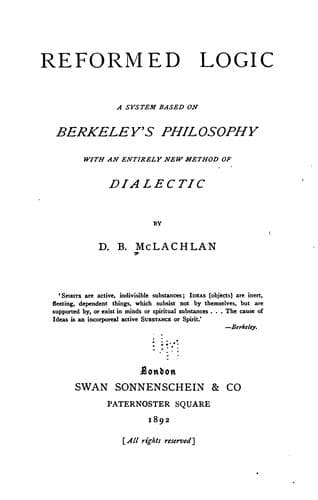
Reformed Logic: A System Based on Berkeley's Philosophy with an Entirely New Method of DialecticMcLachlan, D. B.
Philosophy
Reformed Logic: A System Based on Berkeley's Philosophy with an Entirely New Method of Dialectic
McLachlan, D. B.
Logic
The same 'law,' we are told, holds good in building a dam across a
stream and utilising the force of water to drive a mill. The energy
apparently lost in the construction is recovered in the superior ease
with which we grind our corn or saw our timber. There is a confusion
in the terminology here: to save energy that would otherwise be lost
is not identical with recovering energy that has once been used.
We make a gun, load it, and discharge a bullet against a target. What
has become of the force expended? It has been transformed into heat,
say the conservationists. And when the target and flattened bullet
have cooled down? The energy has gone to raise the general temperature
of the universe!
That is a conclusion hard to believe and impossible to verify.
But--granting that the individual explosions of a gun may be the
'conservation' of some antecedent power--how do we recover the initial
expense of the instrument? And if not recoverable, where at least
and in what form does it exist? Prior to the explosions that are
represented by heated targets and the like, energy was spent in
inventing and making the gun, making the ammunition, loading and
aiming the piece. All these were essential to the effect--and what has
become of them? Have they also gone to warm the universe?
Instead of raising a stone to a height, let us carry it along
horizontally till we feel the same degree of fatigue. If energy in
the using is merely transformed but not lost, we should now be in
possession of some power equivalent to the energy expended. But we are
not--we have nothing to show for our trouble.
If we construct a water-mill and fix it high and dry in the middle of
a plain, instead of under a fall of water, we get no return for the
energy expended. By such a law as the conservation of energy, and
with the usefulness of a properly placed mill as the measure of
compensation, we should receive an equivalent return no matter where
the mill is placed. What has _place_ to do with the action of a
universal law?
Instead of raising the stone or carrying it horizontally, let us
find it near the edge of a precipice and roll it over. There is no
proportion between the push that launched the stone, and the force it
exhibits on reaching the foot of the precipice. How is the equivalence
of energy maintained in this case? It will be replied that the force
now at work is gravitation. If so, it was gravitation that brought
down the first stone on the post--not any energy transferred from us
to the stone. The raising of the stone put us in a position to use the
force of gravity, just as climbing the precipice put us in a position
to roll the stone over the edge of it.
Such considerations as these make this 'law' incredible to me. But
when I pass from the explanation to the concrete facts, I have no
difficulty in understanding them. It is the law that is obscure--not
the facts.
Public-domain text, read in full here on John Shaqi.
Reviews
Reviews
No reviews yet
Be the first to share your thoughts on this work.
Elsewhere in the archive
Join the Discussion
Join the discussion
Sign in to leave a comment or review.
Sign InorCreate an account