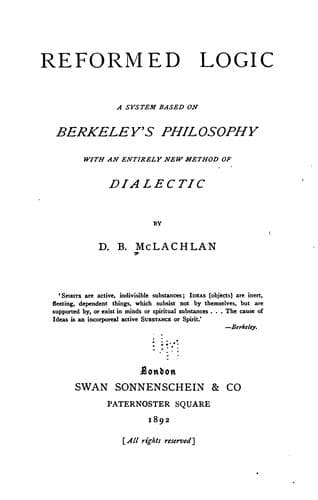
Reformed Logic: A System Based on Berkeley's Philosophy with an Entirely New Method of DialecticMcLachlan, D. B.
Philosophy
Reformed Logic: A System Based on Berkeley's Philosophy with an Entirely New Method of Dialectic
McLachlan, D. B.
Logic
Then energy is not in the least like matter--either the matter of
science or that of philosophy. The energy we really know is a unique
experience--not a general idea, nor anything analogous to a phenomenal
object; so that even if the proposed precedent were true in itself, it
is not applicable to the case. To complete our knowledge of external
energy we must go back to that comparison which first suggested to us
that there is external energy, namely, the comparison of living man
with living nature.
If this is not a correct account of the derivation of the notion that
cosmic energy is indestructible, let conservationists tell us what is
the parallel on which they are arguing. Here is a blank theorem for
completion--
_x_ | is indestructible
-------------------+------------------------------
Cosmic energy is a | _it must therefore be considered
sort of _x_ | indestructible_
Matter, as we have seen, is not _x_. Human energy is not _x_. Our
individual power--so far as experience informs us--is destroyed in
the using. A day's work exhausts us, and we have to pass into the
condition called sleep to be refilled. It is sleep, not food, that
refreshes the mind. Food restores the bodily tool we have been working
with--puts a fresh edge on the chisel,--but it does not recuperate the
power that wields the tool.
What then is _x_?
_NOTE ON DREAMS_
If dreams could be studied with our waking consciousness they
would throw much light on our mental nature. Being a poor
dreamer myself I am not competent to discuss this phase of
psychology as it deserves. I think however the bulk of our
dreams can be reduced to two principles. There is first
the simple lowering of the mental energy, which weakens the
attention and dissolves the artificial categories, thus making
ordinary reason impossible. There is just enough energy left
to revive a few scattered ideas, which blend together
without control or regard to precedent. Hence the singular
combinations they sometimes form.
In the waking state the objective and intellectual
experience are generally more vivid and engrossing than the
sentimental--at least in masculine persons. (I deliberately
avoid the phrase 'masculine mind,' because there is manifestly
no sex in mind.) In dreams the converse of this is the case.
The objects we appear to see are dull and indistinct, being
ideas mistaken for objects, whilst the feelings are evidently
genuine and sometimes of great intensity. This may be
explained on the occult principle alluded to in section X.
Public-domain text, read in full here on John Shaqi.
Reviews
Reviews
No reviews yet
Be the first to share your thoughts on this work.
Elsewhere in the archive
Join the Discussion
Join the discussion
Sign in to leave a comment or review.
Sign InorCreate an account