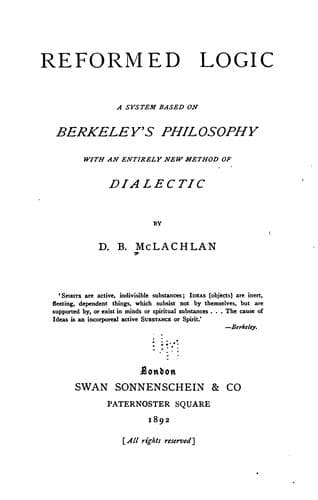
Reformed Logic: A System Based on Berkeley's Philosophy with an Entirely New Method of DialecticMcLachlan, D. B.
Philosophy
Reformed Logic: A System Based on Berkeley's Philosophy with an Entirely New Method of Dialectic
McLachlan, D. B.
Logic
In the question before us the case is Mechanical or Inorganic Energy.
It is not an object, but an inference from the knowledge of our
personal mental energy. This latter is the only energy we really
perceive. But we find in objects, or associated with the perception of
them, a power capable of assisting or of opposing our efforts--hence
we conclude it is something of the same nature as our own power. We
cannot well avoid that inference, and there is no apparent reason why
we should try to avoid it.
So far science and philosophy are at one, but here they part company.
Philosophy consistently endows Nature with sentiency also, for we
never--to our certain knowledge--meet with energy without sentiency,
and we have no right to transfer one attribute without the other.
Although science is indebted to the assimilation of organic and
inorganic--Nature explained by Man--for the first notion of external
energy, no sooner is the notion formed than the argument is discarded,
and external energy is declared to be entirely destitute of an organic
and mental character. How then is it to be further explained? To what
shall it now be likened?
In the materialistic scheme all things are supposed to be resolved
into matter and force. Matter is conceived as a self-existent
substance, indestructible, &c. It is better known than force, for
material things can be directly perceived whereas force is imaginary
all the time. Under these circumstances it is natural though illogical
to treat force as a species of matter. With only two things left in
the universe, the better known of the two will be used to explain the
less known, if an explanation is considered indispensable. Force is
accordingly brought as a 'case' under matter as a 'precedent,' and
is concluded to be indestructible because matter is believed to be
indestructible; and when energy appears to be wasted the inference is
that it has simply withdrawn from view, like an object that has ceased
to be perceived and may be perceived again. That seems to be the
evolution of the scientific notion of inorganic energy.
This theorem is fallacious in two respects. There is no such matter
as science imagines. Matter is a general idea formed by the study
of material objects, which are states of consciousness excited by
noumenal contact. It is the average object--a mere affection or
formation of the observing mind. _We_ are the makers of matter.
Such an idea cannot be said to be indestructible: in a sense it is
destroyed in an individual when it is forgotten or inactive; it
would certainly be destroyed if all minds ceased to form it. Thus the
precedent in the scientific theory of force is itself false.
Public-domain text, read in full here on John Shaqi.
Reviews
Reviews
No reviews yet
Be the first to share your thoughts on this work.
Elsewhere in the archive
Join the Discussion
Join the discussion
Sign in to leave a comment or review.
Sign InorCreate an account