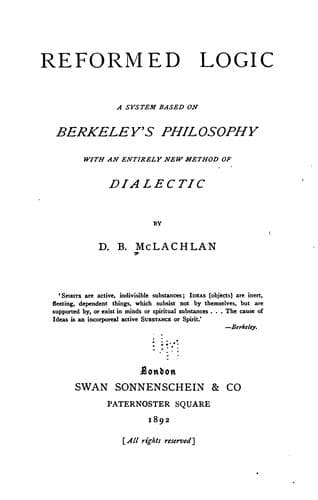
Reformed Logic: A System Based on Berkeley's Philosophy with an Entirely New Method of DialecticMcLachlan, D. B.
Philosophy
Reformed Logic: A System Based on Berkeley's Philosophy with an Entirely New Method of Dialectic
McLachlan, D. B.
Logic
This redaction consists mainly in distinguishing clearly the four
parts composing an argument, namely, the Subject of the Precedent; the
Case which is brought under it for judgment; the Applicate or part of
the precedent bearing on the case; the Conclusion, which is the ideal
judgment concerning the case. When these four parts are expressed and
clearly understood we have a perfect argument, so far as argumentation
depends on language. But probably we have spoiled the language from
the grammatical and rhetorical point of view. We may have had
to supply much that would be redundant and unsightly in ordinary
conversation or writing, and to take away much that is appropriate to
colloquial discourse. We are diverting language to a use for which
it was not designed, and we need not be surprised if the result is
ungraceful. This cannot be helped since there exists no other means
than language by which to express our concrete reasoning.
I have already shown practically how an argument can be arranged so
as to indicate the logical relations subsisting between its parts. A
Greek cross is drawn, and in the four angles thus made the four parts
of the argument are written, or the principal words of each. Begin
with the conclusion, for that is generally the most explicitly given;
then find or supply the part of the precedent that agrees or logically
rhymes with it; next place the subject in the first compartment, and
the case under it. These relative positions should not be varied. When
this has been practiced for a while it enables one to dismember the
most intricate argument with ease and exactness.
The redaction or re-writing of the language can be abbreviated by
regarding the horizontal line as equivalent to a declaration of
resemblance between case and precedent-subject, and (by application)
between the illustrative abstraction and conclusion. If there is an
argument at all there must be this resemblance, and the right-hand
parts must have one of the six categorical relations to the left-hand
parts. The contents of the angles may be cut down to a word or two,
as--
I.
Tyrants | death
--------+--------
Caesar | _death_
If the category be further indicated by a numeral over the upright
line, we have the essential parts of the argument in a very compact
form. The cross and categorical numeral may be regarded as a
sufficient substitute for grammatical syntax and punctuation.
Public-domain text, read in full here on John Shaqi.
Reviews
Reviews
No reviews yet
Be the first to share your thoughts on this work.
Elsewhere in the archive
Join the Discussion
Join the discussion
Sign in to leave a comment or review.
Sign InorCreate an account