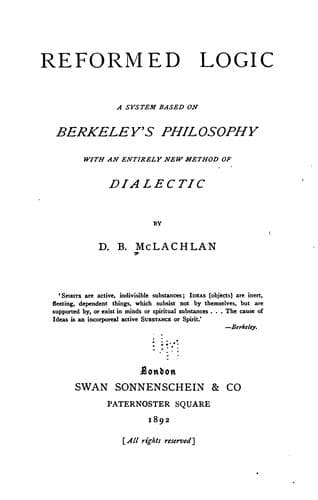
Reformed Logic: A System Based on Berkeley's Philosophy with an Entirely New Method of DialecticMcLachlan, D. B.
Philosophy
Reformed Logic: A System Based on Berkeley's Philosophy with an Entirely New Method of Dialectic
McLachlan, D. B.
Logic
The negative word that generally occurs in stigmatic arguments
requires special attention. It should always be put in the second
angle, and when it may read so as to negative the subject it should
be hyphened to the predicate, thus giving it the value of _non_, _un_,
_im_, or other negative prefix. To say colloquially that 'all Russians
are not angels' leaves room to believe that some Russians are angels,
the 'not' applying to 'all' instead of to 'angels.' By linking 'not'
to 'angels' we get a term equivalent to non-angelic, which expresses
the meaning intended--that no Russians are angels.
Caution should be observed with partitive words like 'some,' 'many,'
'a few,' &c. There is little danger of ambiguity when they occur in
the case, for that means that we bring only a portion of a group
of things to judgment, which we are manifestly entitled to do. The
conclusion however applies only to the portion in question, not to
the rest of the group. 'Honest men deserve respect; some Negroes are
honest men; _these particular Negroes deserve respect_.'
In the precedent, partitive words imply that only some of the subject
have the applicate. If that portion is a dialectical 'all'--that is,
if there has been no exception in the course of our experience--we
may, though that experience has been limited, venture to treat the
applicate as universal and ground a conclusion upon it. If the subject
is really partitive--if we know for certain that some subjects have
the applicate and others have it not--the conclusion must follow the
greater probability. If the number and character of the observed cases
is known we can express the probability arithmetically; it is the
number of occurrences of a given character divided by the total
number.
Redaction must not be used to correct original errors of observation;
its purpose is to render explicit in language what is implicit in
thought, not what might have been thought supposing the thinker had
been more intelligent or industrious than he was.
'Conversion' is a process admitted or required in the artificial
methods of syllogistic dialectic. It consists mainly in transposing
the subject and predicate of a proposition, as 'some Europeans are
Mohammedans'--'some Mohammedans are Europeans,' This operation
never takes place in real argument, or is merely the emendation of a
proposition at first awkwardly expressed. Conversion can take place
only when the predicate is a class, hence the categorical propositions
cannot be converted.
Public-domain text, read in full here on John Shaqi.
Reviews
Reviews
No reviews yet
Be the first to share your thoughts on this work.
Elsewhere in the archive
Join the Discussion
Join the discussion
Sign in to leave a comment or review.
Sign InorCreate an account