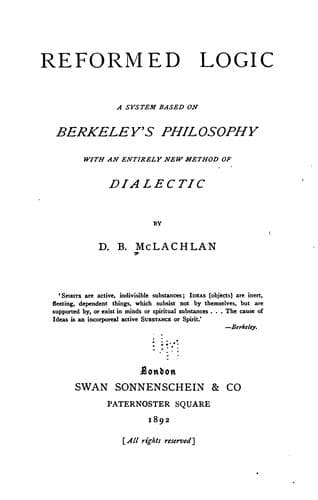
Reformed Logic: A System Based on Berkeley's Philosophy with an Entirely New Method of DialecticMcLachlan, D. B.
Philosophy
Reformed Logic: A System Based on Berkeley's Philosophy with an Entirely New Method of Dialectic
McLachlan, D. B.
Logic
This is the fallacy called in the quaint language of the syllogists
'Illicit Process of the Major Term.'
In _False Analogy_ the resemblance is so slight that the application
is untrustworthy, or a conclusion is drawn in excess of the
resemblance. If from the habit of calling a deep bay or salt-water
loch an 'arm' of the sea from its analogy to a human arm, we conclude
that the sea has elbows and wrists, we commit this fallacy. The earth
is like an orange, but we must not think that it is pulpy inside.
Akin to this is the fallacy of _False Generality_ or _Doubtful
Precedent_. It consists in carelessly or perversely using bad
antecedents when better are available. This applies to such current
prejudices as that all Frenchmen are frivolous, all Germans mystical,
all Jews dishonest, all Carthaginians faithless, all rich people
purseproud, all nobles haughty, and so on. Even if all the
Carthaginians we personally knew had proved faithless, our general
knowledge of mankind should keep us from inferring that a whole
nation should be faithless. The most we should conclude is that _some_
Carthaginians are faithless, but we are free to exercise caution in
future dealings with members of that race. All these generalities
are grounded on this prior argument: 'when a known portion of a class
exhibits certain qualities, we are justified in inferring that the
whole class possess these qualities'--which is only occasionally true.
The fallacy of _Accident_ occurs when the precedent is so defined
as not to exclude exceptions, and the case happens to be one of
the exceptions. 'What gives pain should be abstained from; surgical
operations give pain; they should therefore be abstained from.' The
painful things that should be universally abstained from are those
which give needless or useless pain, not the sort that give less pain
than they remove. Falstaff committed this fallacy when he supposed
that the King would be a boon companion like the Prince. So did the
colonists who introduced rabbits and water-cress into Australia, on
the supposition that they would there have the same function or value
as in Great Britain. In consequence of the Accidental change the
rabbits have developed into a pest, and the water-cress obstructs
navigation.
If the applicate is a property of the subject only when the latter is
taken collectively, it will not yield a true conclusion when the parts
or individuals of the subject are taken separately. All the angles of
a triangle are equal to two right angles, but it does not follow that
one of them--though it resembles the triangle to some extent--is equal
to two right angles. In this instance we should render the meaning
clear by saying 'collectively equal,' when no argument follows and no
mistake is made. This is called the fallacy of _Division_.
Public-domain text, read in full here on John Shaqi.
Reviews
Reviews
No reviews yet
Be the first to share your thoughts on this work.
Elsewhere in the archive
Join the Discussion
Join the discussion
Sign in to leave a comment or review.
Sign InorCreate an account