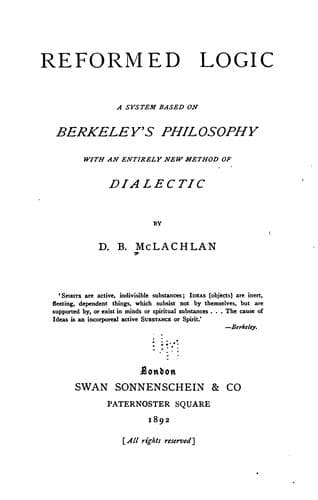
Reformed Logic: A System Based on Berkeley's Philosophy with an Entirely New Method of DialecticMcLachlan, D. B.
Philosophy
Reformed Logic: A System Based on Berkeley's Philosophy with an Entirely New Method of Dialectic
McLachlan, D. B.
Logic
One of the commonest omissions in argumentation is to take the
precedent for granted. This is allowable when it is a fact universally
known or believed. 'If you let the glass fall it will be broken,'--the
omitted precedent is the known consequences of letting brittle
things fall to the ground. 'Caius is a liar, therefore he is a
coward'--presupposes that every liar is a coward.
This liberty of suppression is sometimes used sophistically. The
tacit precedent is not universally known or accepted, but if it is
questioned the sophist is ready with an exclamation of surprise
or contempt at our supposed ignorance. Persons who are afraid of
appearing singular in their beliefs are liable to be deceived by this
trick.
'It frequently happens,' says Whately, 'in the case of a
fallacy [of omitted precedent] that the hearers are left to
the alternative of supplying either a premiss which is not
true, or else one which does not prove the conclusion: _e.g._
if a man expatiates on the distress of the country, and thence
argues that the government is tyrannical, we must suppose him
to assume either that "every distressed country is under a
tyranny," which is a manifest falsehood, or merely that "every
country under a tyranny is distressed," which, however true,
proves nothing, the Middle Term being undistributed.... Which
are we to suppose the speaker meant us to understand? Surely
just whichever each of his hearers might happen to prefer:
some might assent to the false premiss; others allow the
unsound syllogism; to the sophist himself it is indifferent,
as long as they can be brought to admit the conclusion.'
We sometimes attempt to reason from _Contrast_ instead of resemblance,
with a confused notion that things which differ in some respects must
differ also in others. 'Who spareth the rod hateth the child; the
parent who loveth his child must _therefore_ spare not the rod.' The
fallacy of this becomes apparent when we complete the theorem in the
parallel form.
VI.
The hating parent | spares the rod
-------------------------------+---------------
The loving parent differs from | [_No Conclusion_]
the hating parent |
The following has often been presented as a valid argument--'What is
universally believed must be true; the belief in God's existence is
not universal; it is therefore not true.'
I.
What is universally believed | is true
-----------------------------+-------
The existence of God is not | _N. C._
universally believed
To establish the conclusion aimed at, it would be necessary to lay
down as precedent--'What is not universally believed is not true.'
These theorems from contrast are on a par with the following--
I.
Cows | are four-footed
-------------------+--------------------------
Sheep are not cows | _sheep are not four-footed_
Public-domain text, read in full here on John Shaqi.
Reviews
Reviews
No reviews yet
Be the first to share your thoughts on this work.
Elsewhere in the archive
Join the Discussion
Join the discussion
Sign in to leave a comment or review.
Sign InorCreate an account