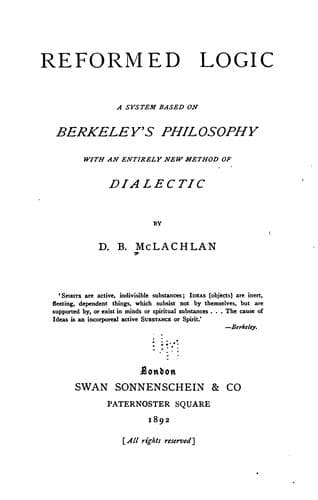
Reformed Logic: A System Based on Berkeley's Philosophy with an Entirely New Method of DialecticMcLachlan, D. B.
Philosophy
Reformed Logic: A System Based on Berkeley's Philosophy with an Entirely New Method of Dialectic
McLachlan, D. B.
Logic
When a book is quoted to prove its own authenticity we have
this fallacy; or when the precedent is as unknown as the
conclusion,--'Paradise was in Armenia, therefore Gihon is an Asiatic
river.'
The academical syllogism as defined--not always as presented--contains
two fallacies, one of which is tautology. 'ALL Europeans are white;
Caius is a European; therefore he is white.' If, as logicians say, the
'all' is absolute and includes Caius even before he is mentioned, then
it is clear that the theorem amounts to saying, 'All Europeans are
white, and one of them is Caius.' 'Both the twins are fair-haired;
Caius is one of the twins; therefore he is fair-haired':--the
pretended conclusion is merely a naming of a part of the precedent.
The first of these theorems may be interpreted so as to give a valid
conclusion. We are informed that an unknown person called Caius is a
European; we are not told, and we do not know, what is the colour of
his skin; but because all the Europeans we have known have been white,
we infer--pending actual knowledge--that Caius is white. Logicians
interpret the syllogism otherwise, for they have a notion that reason
should give infallible certainty.
After the precedent has been divided into subject and applicate,
the former is sometimes used as applicate and so generates a wrong
conclusion. This may be called _Cross Reasoning_ or _Diagonal
Reasoning_--the fallacy termed by logicians 'Undistributed Middle.'
Manx cats | have no tails
---------------------+----------------------
This cat has no tail | _it must be a Manx cat_
De Morgan has this example--'His imbecility of character might have
been inferred from his proneness to favourites; for all weak princes
have this failing.'
All weak princes | are prone
-----------------+------------------------
He was prone | _he must have been weak_
Statements are sometimes put forward as reasoning which contain no
case, either expressed or understood. This will seem hardly
credible seeing that the illustration of a case is the purpose of
argumentation. Not only does it occur, but a certain form of it is
regarded by some logicians as valid reasoning. It is the 'particular'
syllogism of the Third Figure.
_Socrates was poor;
Socrates was wise._
From these premises no conclusion can be extracted, unless it be the
verbal summary--'Socrates was both poor and wise.' But logicians draw
from it the dialectic conclusion--
_Therefore some men have been poor and wise_,
or
_Therefore one man has been poor and wise_.
Public-domain text, read in full here on John Shaqi.
Reviews
Reviews
No reviews yet
Be the first to share your thoughts on this work.
Elsewhere in the archive
Join the Discussion
Join the discussion
Sign in to leave a comment or review.
Sign InorCreate an account