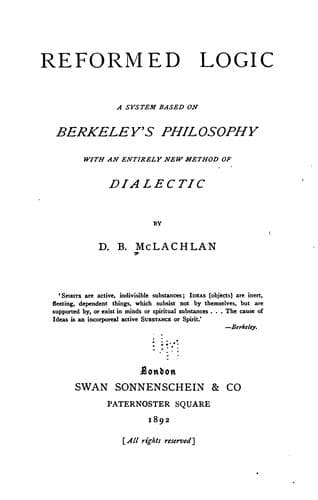
Reformed Logic: A System Based on Berkeley's Philosophy with an Entirely New Method of DialecticMcLachlan, D. B.
Philosophy
Reformed Logic: A System Based on Berkeley's Philosophy with an Entirely New Method of Dialectic
McLachlan, D. B.
Logic
Both these conclusions are inadmissible. It is because they are
empirically true that we are apt to think their truth depends on the
antecedent information. If we wish to extend the qualities of Socrates
to 'some men' we must make them a case with 'Socrates is poor and
wise' for a precedent, but I fail to see how it is to be done. If we
add to the premises, 'One man was Socrates, therefore one man was poor
and wise,' we have a tautological fallacy.
J. S. Mill notices a fallacy which amounts to an _Inversion_ of the
Parallel: the conclusion is known or believed and the truth of the
antecedents is inferred backwards.
'People continually think and express themselves as if they
believed that the premises cannot be false if the conclusion
is true. The truth, or supposed truth, of the inferences which
follow from a doctrine, often enables it to find acceptance
in spite of gross absurdities in it. How many philosophical
systems which had scarcely any intrinsic recommendation have
been received by thoughtful men because they were supposed to
lend additional support to religion, morality, some favourite
view of politics, or some other cherished persuasion; not
merely because their wishes were thereby enlisted on its side,
but because its leading to what they deemed sound conclusions
appeared to them a strong presumption in favour of its
truth, though the presumption, when viewed in its true light,
amounted only to the absence of that particular evidence
of falsehood which would have resulted from its leading by
correct inference to something already known to be false.'[19]
The conclusion of an argument may sometimes be left unexpressed. If
the antecedents are strong and the conclusion obvious it weakens the
argument to state the conclusion in full, besides reflecting on the
capacity of the reader or hearer to draw the conclusion for himself.
Hence we find at the end of controversial and indignant writings such
expressions as--'Comment is superfluous'--'We leave the reader to draw
his own conclusions,'--or simply a point of exclamation is appended.
Sophistical insinuations are suggested in this manner. A train of
ideas is laid that generates a conclusion which the speaker is afraid
or ashamed to put into words.
The second fault of the syllogism as defined may be called the fallacy
of _No Application_. It consists in arranging propositions so as to
end in a classification, but no applicate is detached and no rational
conclusion is drawn. 'Jones is a Welshman; all Welshmen are Britons;
therefore Jones is a Briton.' If in actual thinking it were ever
desired to establish by argument that Jones is a Briton, it would be
with the object of applying to him some quality connoted by Briton,
but the presence of which in Jones is a matter of doubt. This would be
a conclusion--but not the mere classification.
Public-domain text, read in full here on John Shaqi.
Reviews
Reviews
No reviews yet
Be the first to share your thoughts on this work.
Elsewhere in the archive
Join the Discussion
Join the discussion
Sign in to leave a comment or review.
Sign InorCreate an account