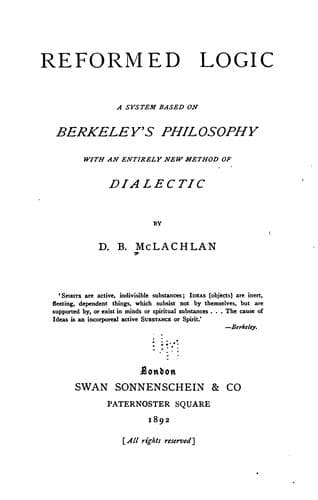
Reformed Logic: A System Based on Berkeley's Philosophy with an Entirely New Method of DialecticMcLachlan, D. B.
Philosophy
Reformed Logic: A System Based on Berkeley's Philosophy with an Entirely New Method of Dialectic
McLachlan, D. B.
Logic
Immediate Inference--
Arithmetical Calculation--
Geometrical Demonstration--
Induction--
Aristotle's Dictum--
Mediate Comparison--
Syllogism.
XXXII--IMMEDIATE INFERENCE
Some logicians maintain that it is possible to draw a kind of
conclusions from one judgment alone. These pretended conclusions are
of two species.
The first is a restatement in different words of the whole or part
of the single idea, and it is preceded by 'therefore' to give it
the appearance of an argument. 'All men suffer, therefore some men
suffer.' 'John is a man, therefore he is a living creature.' 'This
weighs that down, therefore it is heavier.' These are all obvious
tautologisms. It is not an inference to deny the opposite of what we
have asserted, as 'The weather is warm, therefore it is not cold.'
The conditional and dilemmatic examples of logicians abound in such
'inferences.' We cannot entirely avoid these locutions, as they give
point and clearness to speech, but they are not argument, even when
introduced by 'therefore.'
The other species of spurious conclusions arises out of what is
technically called Conversion. This is a process permitted in
Syllogistic in order to render propositions more explicit. The subject
may change places with the predicate, a 'some' may be inserted, an
'all' suppressed, or a 'not' may be made to qualify one word instead
of another. In all this there must be no change in the meaning of the
proposition, and therefore there can be no inference. If the second
proposition means something more or different from the first,
another premise is unconsciously taken for granted, or the supposed
interpretation amounts to interpolation. The reasoner may have
inadvertently or sophistically added something to the original datum.
Here is an example of inference by conversion--'All cabbages are
plants, therefore _some_ plants are cabbages.' If it is not understood
from the terms of the first proposition that plants are limited to
such as are cabbages, the 'some' of the converted proposition is an
interpolation supplied from the reasoner's knowledge of the matter. In
this case the 'quantification' of plants is not a valid inference from
the original information.
XXXIII--ARITHMETICAL CALCULATION
Public-domain text, read in full here on John Shaqi.
Reviews
Reviews
No reviews yet
Be the first to share your thoughts on this work.
Elsewhere in the archive
Join the Discussion
Join the discussion
Sign in to leave a comment or review.
Sign InorCreate an account