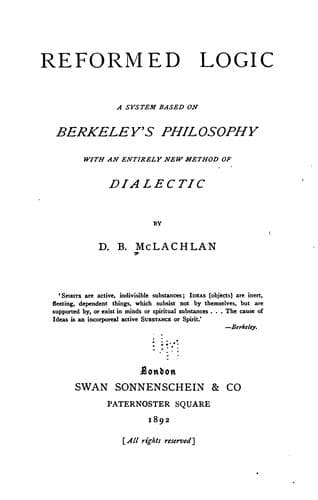
Reformed Logic: A System Based on Berkeley's Philosophy with an Entirely New Method of DialecticMcLachlan, D. B.
Philosophy
Reformed Logic: A System Based on Berkeley's Philosophy with an Entirely New Method of Dialectic
McLachlan, D. B.
Logic
Arithmetic is first a manipulation of symbols called 'figures.' There
are ten of these, and they are capable of many species of combination,
and an indefinite number of individual operations under each species.
Certain rules govern each sort of operation, and when the rules are
properly understood and recollected the operations can be performed
with absolute certainty. Although the figures have names relating to
number, and the problems given for exercise make mention of acres,
pounds, tons, miles, and all sorts of concrete objects, the symbolic
calculations of books have no necessary relation to real things,
numbers, or quantities. They are a purely conventional treatment
of arbitrary marks that may mean anything or nothing. That is the
arithmetic of the 'schools.' There is no trace of reasoning or
argument in it--it is mere rule and recollection.
There is however real Number and there is real Quantity. Number is
that quality in which a group of three things (for instance) is seen
to differ from a group of four or seven, even when the things are
otherwise quite similar. We begin by distinguishing ten primary
degrees of this difference, and then consider other degrees as
multiples or parts of these primary degrees.
Quantity is degree in size, and is a property quite different from
number. But, for convenience, we assume that quantities are all units
or fractions of certain standard quantities, and we are thus enabled
to use the same terms for both number and quantity.
The names which written language provides for the numerical degrees
and their combinations are inconvenient to use, and so a set of
symbols was devised exclusively for numerical designation. These
are the figures of arithmetic. They are the technical vocabulary of
number, and of quantity considered as number.
Number and quantity admit of but two kinds of variation--increase and
diminution. These variations can be denoted so correctly by figures,
that any combination we first make in figures according to rule can be
reproduced in real objects, provided the objects are in other respects
possible. The result of this perfection of technical nomenclature is
that our study of number and quantity has been transferred from real
objects to figures. It has become symbolic and indirect, and most of
us never go beyond the symbols; that is, what we call arithmetic is
an affair of figures, not of true quantities and numbers. We talk
of miles, tons, and pounds sterling, but we do not _think_ of miles,
tons, and pounds sterling--we think of _figures_. A thousand shillings
is to us, when arithmetically stated, '1000_s._,' just as it is here
represented on paper; we do not think of silver coins, and we could
not if we tried imagine a thousand things of any sort. There is in
reality an enormous difference between '0001_s._' and '1000_s._,'
but to the arithmetician the only objective difference is one of
arrangement in figures.
Public-domain text, read in full here on John Shaqi.
Reviews
Reviews
No reviews yet
Be the first to share your thoughts on this work.
Elsewhere in the archive
Join the Discussion
Join the discussion
Sign in to leave a comment or review.
Sign InorCreate an account