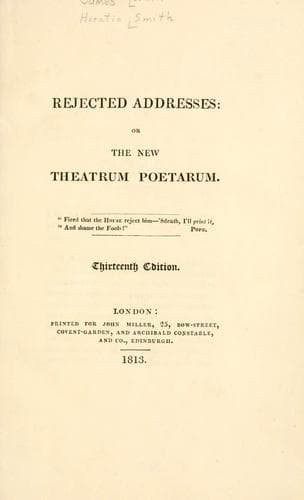
Rejected Addresses; Or, The New Theatrum PoetarumSmith, James
General
Rejected Addresses; Or, The New Theatrum Poetarum
Smith, James
Parodies
{0d} This was Horatio, the writer of the present Preface. The envelope
which enclosed his Address to the Committee was sold with two volumes of
the original Addresses at Mr. Winston’s sale, Dec. 14, 1849, and was
inscribed inside “Horatio Smith, 36, Basinghall Street.”
{0e} The passage, as originally written, continued thus: “and among
others, so difficult is it to form a correct judgment in catering to the
public taste, by the very bibliopolist who has now, after an interval of
twenty [_only_ seven] years, purchased the copyright from a brother
bookseller, and ventured upon the present edition.” To this, on the
proof-sheet, the late Mr. Murray appended the following note:—“I never
saw or even had the MS. in my possession; but knowing that Mr. Smith was
brother-in-law to Mr. Cadell, I took it for granted that the MS. had been
previously offered to him and declined.” Mr. H. Smith consequently drew
his pen through the passage.
{0f} Between 1807 and 1810. The _Monthly Mirror_ was edited by Edward
Du Bois, author of “My Pocket-Book,” and by Thomas Hill; the original
Paul Pry; and the Hull of Mr. Theodore Hook’s novel of “Gilbert Gurney.”
{0g} Miss Lydia White, celebrated for her lively wit and for her
blue-stocking parties, unrivalled, it is said, in “the soft realm of
_blue_ May Fair.” She died in 1827, and is mentioned in the diaries of
Scott and Byron.
{0h} See note on “The Beautiful Incendiary,” p. 56.
{1} “The first piece, under the name of the loyal Mr. Fitzgerald, though
as good we suppose as the original, is not very interesting. Whether it
be very like Mr. Fitzgerald or not, however, it must be allowed that the
vulgarity, servility, and gross absurdity of the newspaper scribblers is
well rendered.”—JEFFREY, _Edinburgh Review_.
WILLIAM THOMAS FITZGERALD.—The annotator’s first personal knowledge of
this gentleman was at Harry Greville’s Pic-Nic Theatre, in
Tottenham-street, where he personated Zanga in a wig too small for his
head. The second time of seeing him was at the table of old Lord Dudley,
who familiarly called him Fitz, but forgot to name him in his will. The
Viscount’s son (recently deceased), however, liberally supplied the
omission by a donation of five thousand pounds. The third and last time
of encountering him was at an anniversary dinner of the Literary Fund, at
the Freemasons’ Tavern. Both parties, as two of the stewards, met their
brethren in a small room about half an hour before dinner. The
lampooner, out of delicacy, kept aloof from the poet. The latter,
however, made up to him, when the following dialogue took place:
Fitzgerald (with good humour). “Mr. —, I mean to recite after dinner.”
Mr. —. “Do you?”
Fitzgerald. “Yes: you’ll have more of ‘God bless the Regent and the Duke
of York!’”
The whole of this imitation, after a lapse of twenty years, appears to
the Authors too personal and sarcastic; but they may shelter themselves
under a very broad mantle:
Public-domain text, read in full here on John Shaqi.
Reviews
Reviews
No reviews yet
Be the first to share your thoughts on this work.
Elsewhere in the archive
Join the Discussion
Join the discussion
Sign in to leave a comment or review.
Sign InorCreate an account