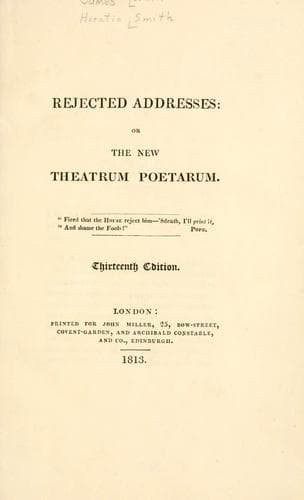
Rejected Addresses; Or, The New Theatrum PoetarumSmith, James
General
Rejected Addresses; Or, The New Theatrum Poetarum
Smith, James
Parodies
“Let hoarse Fitzgerald bawl
His creaking couplets in a tavern-hall.”—Byron.
Fitzgerald actually sent in an address to the Committee on the 31st of
August, 1812. It was published among the other _Genuine Rejected
Addresses_, in one volume, in that year. The following is an extract:—
“The troubled shade of Garrick, hovering near,
Dropt on the burning pile a pitying tear.”
What a pity that, like Sterne’s recording angel, it did not succeed in
blotting the fire out for ever! That failing, why not adopt Gulliver’s
remedy?
{2} Mr. B. Wyatt, architect of Drury Lane Theatre, son of James Wyatt,
architect of the Pantheon.
{3a} In plain English, the Halfpenny hatch, then a footway through
fields; but now, as the same bards sing elsewhere—
“St. George’s Fields are fields no more,
The trowel supersedes the plough;
Swamps huge and inundate of yore,
Are changed to civic villas now.”
{3b} Covent Garden Theatre was burnt down 20th September, 1808; Drury
Lane Theatre (as before stated) 24th February, 1809.
{4a} The east end of St. James’s Palace was destroyed by fire, 21 Jan.,
1809. The wardrobe of Lady Charlotte Finch (alluded to in the next line)
was burnt in the fire.
{4b} Honourable William Wellesley Pole, now (1854) Earl of Mornington,
married, 14th March, 1812, Catherine, daughter and heir of Sir James
Tylney Long, Bart; upon which occasion he assumed the additional names of
Tylney and Long.
{5a} “The author does not, in this instance, attempt to copy any of the
higher attributes of Mr. Wordsworth’s poetry; but has succeeded perfectly
in the imitation of his mawkish affectations of childish simplicity and
nursery stammering. We hope it will make him ashamed of his _Alice
Fell_, and the greater part of his last volumes—of which it is by no
means a parody, but a very fair, and indeed we think a flattering,
imitation.”—JEFFERY, _Edinburgh Review_.
{5b} Jack and Nancy, as it was afterwards remarked to the Authors, are
here made to come into the world at periods not sufficiently remote. The
writers were then bachelors. One of them [James], unfortunately, still
continues so, as he has thus recorded in his niece’s album:
“Should I seek Hymen’s tie,
As a poet I die—
Ye Benedicks, mourn my distresses!
For what little fame
Is annexed to my name
Is derived from _Rejected Addresses_.”
The blunder, notwithstanding, remains unrectified. The reader of poetry
is always dissatisfied with emendations: they sound discordantly upon the
ear, like a modern song, by Bishop or Braham, introduced in _Love in a
Village_.
Public-domain text, read in full here on John Shaqi.
Reviews
Reviews
No reviews yet
Be the first to share your thoughts on this work.
Elsewhere in the archive
Join the Discussion
Join the discussion
Sign in to leave a comment or review.
Sign InorCreate an account