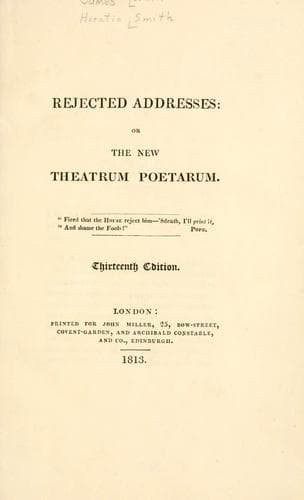
Rejected Addresses; Or, The New Theatrum PoetarumSmith, James
General
Rejected Addresses; Or, The New Theatrum Poetarum
Smith, James
Parodies
“Blow, wind—come, rack, in ages yet unborn,
Our castle’s strength shall laugh a siege to scorn”—
the theatre fell a victim to the flames within fifteen years from the
prognostic! These preparations against fire always presuppose presence
of mind and promptness in those who are to put them into action. They
remind one of the dialogue, in Morton’s _Speed the Plough_, between Sir
Able Handy and his son Bob:
“_Bob_. Zounds, the castle’s on fire!
_Sir A_. Yes.
_Bob_. Where’s your patent liquid for extinguishing fire?
_Sir A_. It is not mixed.
_Bob_. Then where’s your patent fire-escape?
_Sir A_. It is not fixed.
_Bob_. You are never at a loss?
_Sir A_. Never.
_Bob_. Then what do you mean to do?
_Sir A_. I don’t know.”
{17} A rather obscure mode of expression for _Jews’_-harp; which some
etymologists allege, by the way, to be a corruption of _Jaws’_-harp. No
connection, therefore, with King David.
{20} The Weekly Register, which he kept up without the failure of a
single week from its first publication till his death—a period of above
thirty-three years.
{21} Bagshaw. At that time the publisher or Cobbett’s Register.
{22} The old Lyceum Theatre, pulled down by Mr. Arnold. That since
destroyed by fire [16th Feb., 1830] was erected on its site. [The Drury
Lane Company performed at the Lyceum till the house was rebuilt.]
{23a} The present colonnade in Little Russell Street formed no part of
the original design, and was erected only a few years back.
{23b} An allusion to a murder then recently committed on Barnes Terrace.
[The murder (22nd July, 1812) of the Count and Countess D’Antraigues
(distantly related to the Bourbons), by a servant out of livery of the
name of Laurence—an Italian or Piedmontese, who made away with himself
immediately after.]
{24a} At that time keeper of Newgate. The present superintendent (1833)
is styled Governor!
{24b} A portentous one that made its appearance in the year 1811; in the
midst of the war,
“with fear of change
Perplexing nations.”
{25} “_The Living Lustres_ appears to us a very fair imitation of the
fantastic verses which that ingenious person, Mr. Moore, indites when he
is merely gallant, and, resisting the lures of voluptuousness, is not
enough in earnest to be tender.” —JEFFREY, _Edinburgh Review_.
{26} This alludes to two massive pillars of verd antique which then
flanked the proscenium, but which have since been removed. Their colour
reminds the bard of the Emerald Isle, and this causes him (_more suo_) to
fly off at a tangent, and Hibernicise the rest of the poem.
Public-domain text, read in full here on John Shaqi.
Reviews
Reviews
No reviews yet
Be the first to share your thoughts on this work.
Elsewhere in the archive
Join the Discussion
Join the discussion
Sign in to leave a comment or review.
Sign InorCreate an account