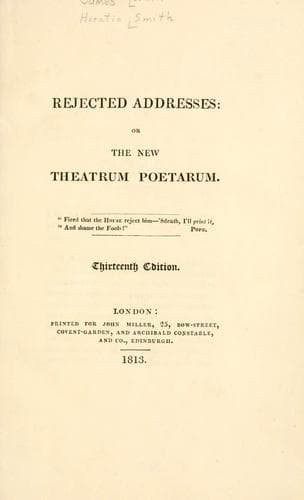
Rejected Addresses; Or, The New Theatrum PoetarumSmith, James
General
Rejected Addresses; Or, The New Theatrum Poetarum
Smith, James
Parodies
One of this extraordinary man’s allegations was, that “fat is an oily
dropsy.” To stave off its visitation, he frequently chewed tobacco in
lieu of dinner, alleging that it absorbed the gastric juice of the
stomach, and prevented hunger. “Pass your hand down my side,” said his
Lordship to the writer; “can you count my ribs?” “Every one of them.”
“I am delighted to hear you say so. I called last week on Lady —; ‘Ah,
Lord Byron,’ said she, ‘how fat you grow!’ But you know Lady — is fond
of saying spiteful timings!” Let this gossip be summed up with the words
of Lord Chesterfield, in his character of Bolingbroke: “Upon the whole,
on a survey of this extraordinary character, what can we say, but ‘Alas,
poor human nature!’”
His favourite Pope’s description of man is applicable to Byron
individually:
“Chaos of thought and passion all confused,
Still by himself abused or disabused;
Created part to rise and part to fall,
Great lord of all things, yet a slave to all;
Sole judge of truth, in endless error hurled—
The glory, jest, and riddle of the world.”
The writer never heard him allude to his deformed foot except upon one
occasion, when, entering the green-room of Drury-lane, he found Lord
Byron alone, the younger Byrne and Miss Smith the dancer having just left
him, after an angry conference about a _pas suel_. “Had you been here a
minute sooner,” said Lord B., “you would have heard a question about
dancing referred to me:—me! (looking mournfully downward) whom fate from
my birth has prohibited from taking a single step.”
{14} The first stanza (see Preface) was written by James Smith; the
remainder by Horace.
{15a} See Note, p. 8.
{15b} “Holland’s edifice.” The late theatre was built by Holland the
architect. The writer visited it on the night of its opening [April 21,
1794]. The performances were _Macbeth_ and the _Virgin Unmasked_.
Between the play and the farce, an excellent epilogue, written by George
Colman, was excellently spoken by Miss Farren. It referred to the iron
curtain which was, in the event of fire, to be let down between the stage
and the audience, and which accordingly descended, by way of experiment,
leaving Miss Farren between the lamps and the curtain. The fair speaker
informed the audience, that should the fire break out on the stage (where
it usually originates), it would thus be kept from the spectators;
adding, with great solemnity—
“No! we assure our generous benefactors
’Twill only burn the scenery and the actors!”
A tank of water was afterwards exhibited, in the course of the epilogue,
in which a wherry was rowed by a real live man, the band playing—
“And did you not hear of a jolly young waterman?”
Miss Farren reciting—
“Sit still, there’s nothing in it,
We’ll undertake to drown you in a single minute.”
“O vain thought!” as Othello says. Notwithstanding the boast in the
epilogue—
Public-domain text, read in full here on John Shaqi.
Reviews
Reviews
No reviews yet
Be the first to share your thoughts on this work.
Elsewhere in the archive
Join the Discussion
Join the discussion
Sign in to leave a comment or review.
Sign InorCreate an account