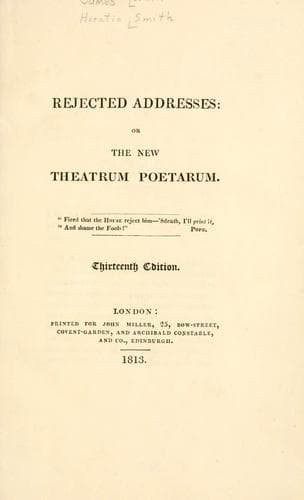
Rejected Addresses; Or, The New Theatrum PoetarumSmith, James
General
Rejected Addresses; Or, The New Theatrum Poetarum
Smith, James
Parodies
{32} “From the knobb’d bludgeon to the taper switch.” This image is not
the creation of the poets: it sprang from reality. The Authors happened
to be at the Royal Circus when “God save the King” was called for,
accompanied by a cry of “Stand up!” and “Hats off!” An inebriated naval
lieutenant, perceiving a gentleman in an adjoining box slow to obey the
call, struck his hat off with his stick, exclaiming, “Take off your hat,
sir!” The other thus assaulted proved to be, unluckily for the
lieutenant, Lord Camelford, the celebrated bruiser and duellist. A
set-to in the lobby was the consequence, where his lordship quickly
proved victorious. “The devil is not so black as he is painted,” said
one of the Authors to the other; “let us call upon Lord Camelford, and
tell him that we were witnesses of his being first assaulted.” The visit
was paid on the ensuing morning at Lord Camelford’s lodgings, in
Bond-street. Over the fire place in the drawing-room were ornaments
strongly expressive of the pugnacity of the peer. A long thick bludgeon
lay horizontally supported by two brass hooks. Above this was placed
parallel one of lesser dimensions, until a pyramid of weapons gradually
arose, tapering to a horsewhip:
“Thus all below was strength, and all above was grace.”
Lord Camelford received his visitants with great civility, and thanked
them warmly for the call; adding, that their evidence would be material,
it being his intention to indict the lieutenant for an assault. “All I
can say in return is this,” exclaimed the peer with great cordiality, “if
ever I see you engaged in a row, upon my soul I’ll stand by you.” The
Authors expressed themselves thankful for so potent an ally, and
departed. In about a fortnight afterwards [March 7, 1804] Lord Camelford
was shot in a duel with Mr. Best.
{34} Veeshnoo. The late Mr. Whitbread.
{36} Levy. An insolvent Israelite who [18th January, 1810] threw
himself from the top of the Monument a short time before. An inhabitant
of Monument-yard informed the writer that he happened to be standing at
his door talking to a neighbour, and looking up at the top of the pillar,
exclaimed, “Why, here’s the flag coming down.” “Flag!” answered the
other, “it’s a man.” The words were hardly uttered when the suicide fell
within ten feet of the speakers.
{38a} “‘Drury’s Dirge,’ by Laura Matilda, is not of the first quality.
The verses, to be sure, are very smooth, and very nonsensical—as was
intended; but they are not so good as Swift’s celebrated Song by a Person
of Quality; and are so exactly in the same measure, and on the same plan,
that it is impossible to avoid making the comparison.”—JEFFREY,
_Edinburgh Review_.
{38b} The Authors, as in gallantry bound, wish this lady to continue
anonymous.
Public-domain text, read in full here on John Shaqi.
Reviews
Reviews
No reviews yet
Be the first to share your thoughts on this work.
Elsewhere in the archive
Join the Discussion
Join the discussion
Sign in to leave a comment or review.
Sign InorCreate an account