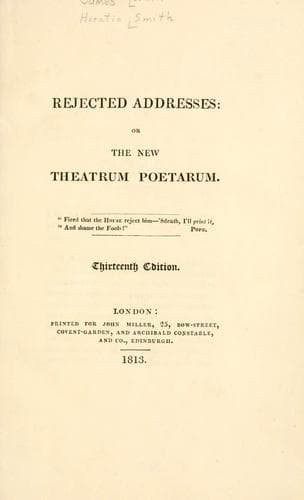
Rejected Addresses; Or, The New Theatrum PoetarumSmith, James
General
Rejected Addresses; Or, The New Theatrum Poetarum
Smith, James
Parodies
{42} From the parody of Walter Scott we know not what to select—it is
all good. The effect of the fire on the town, and the description of a
fireman in his official apparel, may be quoted as amusing specimens of
the _misapplication_ of the style and metre of Mr. Scott’s admirable
romances.—_Quarterly Review_.
“‘A Tale of Drury,’ by Walter Scott, is, upon the whole, admirably
executed; though the introduction is rather tame. The burning is
described with the mighty minstrel’s characteristic love of localities .
. . The catastrophe is described with a spirit not unworthy of the name
so venturously assumed by the describer.”—JEFFREY, _Edinburgh Review_.
“Thus he went on, stringing one extravagance upon another, in the style
his books of chivalry had taught him, and imitating, as neat as he could,
their very phrase.”—DON QUIXOTE.
* * * * *
Sir Walter Scott informed the annotator, that at one time he intended to
print his collected works, and had pitched upon this identical quotation
as a motto;—a proof that sometimes great wits jump with little ones.
{43a} Alluding to the then great distance between the picture-frame, in
which the green curtain was set, and the band. For a justification of
this, see below—“DR. JOHNSON.”
{43b} The old name for London:
For poets you can never want ’em
Spread through Augusta Trinobantum—SWIFT.
Thomson in his “Seasons” calls it “huge Augusta.”
{45} Old Bedlam, at that time, stood “close by London Wall.” It was
built after the model of the Tuileries, which is said to have given the
French king great offence. In front of it Moorfields extended, with
broad gravel walks crossing each other at right angles. These the writer
well recollects; and Rivaz, an underwriter at Lloyd’s, his told him that
he remembered when the merchants of London would parade these walks on a
summer evening with their wives and daughters. But now, as a punning
brother bard sings,—
“Moorfields are fields no more.”
{46a} A narrow passage immediately adjoining Drury Lane Theatre, and so
called from the vineyard attached to Covent or Convent Garden.
{46b} The Hand-in-Hand Insurance Office was one of the very first
insurance offices established in London. To make the engineer of the
office thus early in the race is a piece of historical accuracy intended
it is said, on the part of the writer.
{48} Charge, Chester, charge! On, Stanley, on!
Were the last words of Marmion.
{49} Whitbread’s shears. An economical experiment of that gentleman.
The present portico, towards Brydges-street, was afterwards erected under
the lesseeship of Elliston, whose portrait in the Exhibition was thus
noticed in the Examiner “Portrait of the great Lessee, in his favourite
character of Mr. Elliston.”
Public-domain text, read in full here on John Shaqi.
Reviews
Reviews
No reviews yet
Be the first to share your thoughts on this work.
Elsewhere in the archive
Join the Discussion
Join the discussion
Sign in to leave a comment or review.
Sign InorCreate an account