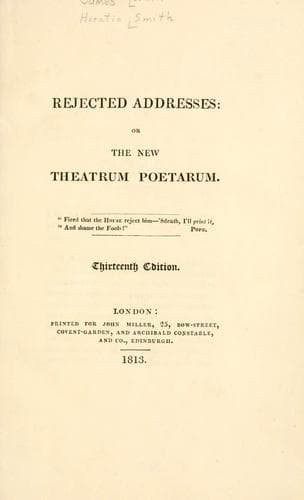
Rejected Addresses; Or, The New Theatrum PoetarumSmith, James
General
Rejected Addresses; Or, The New Theatrum Poetarum
Smith, James
Parodies
{52} “Samuel Johnson is not so good: the measure and solemnity of his
sentences, in all the limited variety of their structure, are indeed
imitated with singular skill; but the diction is caricatured in a vulgar
and unpleasing degree. To make Johnson call a doer ‘a ligneous
barricado,’ and its knocker and bell its ‘frappant and tintinnabulant
appendages,’ is neither just nor humorous; and we are surprised that a
writer who has given such extraordinary proofs of his talent for finer
ridicule and fairer imitation, should have stooped to a vein of
pleasantry so low, and so long ago exhausted; especially as, in other
passages of the same piece, he has shown how well qualified he was both
to catch and to render the true characteristics of his original. The
beginning, for example, we think excellent.”—JEFFREY, _Edinburgh Review_.
{54a} The celebrated Lord Chesterfield, whose Letters to his Son,
according to Dr. Johnson, inculcate “the manners of a dancing-master and
the morals of a —,” &c.
{54b} Lord Mayor of the theatric sky. This alludes to Leigh Hunt, who,
in _The Examiner_, at this time kept the actors in hot water. Dr.
Johnson’s argument is, like many of his other arguments, specious, but
untenable; that which it defends has since been abandoned as
impracticable. Mr. Whitbread contended that the actor was like a
portrait in a picture, and accordingly placed the green curtain in a
gilded frame remote from the foot-lights; alleging that no performer
should mar the illusion by stepping out of the frame. Dowton was the
first actor who, like Manfred’s ancestor in the _Castle of Otranto_, took
the liberty of abandoning the canon. “Don’t tell me of frames and
pictures,” ejaculated the testy comedian; “if I can’t be heard by the
audience in the frame, I’ll walk out of it!” The proscenium has since
been new-modelled, and the actors thereby brought nearer to the audience.
{56a} “‘The Beautiful Incendiary,’ by the Honourable W. Spencer, is also
an imitation of great merit. The flashy, fashionable, artificial style
of this writer, with his confident and extravagant compliments, can
scarcely be said to be parodied in such lines.”—JEFFREY, _Edinburgh
Review_.
{56b} Sobriety, &c. The good-humour of the poet upon occasion of this
parody has been noticed in the Preface. “It’s all very well for once,”
said he afterwards, in comic confidence, at his villa at Petersham, “but
don’t do it again. I had been almost forgotten when you revived me; and
now all the newspapers and reviews ring with this fashionable, trashy
author.’” The sand and “filings of glass,” mentioned in the last stanza,
are referable to the well-known verses of the poet apologising to a lady
for having paid an unconscionably long morning visit; and where, alluding
to Time, he says—
“All his sands are diamond sparks,
That glitter as they pass.”
Public-domain text, read in full here on John Shaqi.
Reviews
Reviews
No reviews yet
Be the first to share your thoughts on this work.
Elsewhere in the archive
Join the Discussion
Join the discussion
Sign in to leave a comment or review.
Sign InorCreate an account