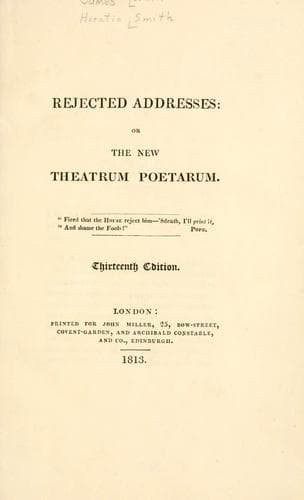
Rejected Addresses; Or, The New Theatrum PoetarumSmith, James
General
Rejected Addresses; Or, The New Theatrum Poetarum
Smith, James
Parodies
“Six years had pass’d, and forty ere the six,
When Time began to play his usual tricks:
My locks, once comely in a virgin’s sight,
Locks of pure brown, now felt th’ encroaching white;
Gradual each day I liked my horses less,
My dinner more—I learnt to play at chess.”
“That’s very good!” cried the bard;—“whose to it?” “Your own.” “Indeed!
hah! well, I had quite forgotten it.” Was this affectation, or was it
not? In sooth, he seemed to push simplicity to puerility. This
imitation contained in manuscript the following lines, after describing
certain Sunday newspaper critics who were supposed to be present at a new
play, and who were rather heated in their politics:—
“Hard is the task who edits—thankless job!—
A Sunday journal for the factious mob
With bitter paragraph and caustic jest,
He gives to turbulence the day of rest;
Condemn’d, this week, rash rancour to instil,
Or thrown aside, the next, for one who will:
Alike undone or if he praise or rail
(For this affects his safety, that his sale),
He sinks at last, in luckless limbo set,
If loud for libel, and if dumb for debt.”
They were, however, never printed; being, on reflection, considered too
serious for the occasion.
It is not a little extraordinary that Crabbe, who could write with such
rigour, should descend to such lines as the following:—
“Something bad happen’d wrong about a bill
Which was not drawn with true mercantile skill,
So, to amend it, I was told to go
And seek the firm of Clutterbuck and Co.”
Surely “Emanuel Jennings,” compared with the above, rises to sublimity.
[“‘The Theatre,’ by the Rev. G. Crabbe, we rather think, is the best
piece in the collection. It is an exquisite and most masterly imitation,
not only of the peculiar style, but of the taste, temper, and manner of
description of that most original author; and can hardly be said to be in
any respect a caricature of that style or manner—except in the excessive
profusion of puns and verbal jingles—which, though undoubtedly to be
ranked among his characteristics, are never so thick sown in his original
works as in this admirable imitation. It does not aim, of course, at any
shadow of his pathos or moral sublimity, but seems to us to be a
singularly faithful copy of his passages of mere description,”—JEFFREY,
_Edinburgh Review_.]
{88} You were more feeling than I was, when you read the excellent
parodies of the young men who wrote the “Rejected Addresses.” There is a
little ill-nature—and I take the liberty of adding, undeserved
ill-nature—in their prefatory address; but in their versification they
have done me admirably. They are extraordinary men; but it is easier to
imitate style than to furnish matter.—CRABBE (_Works_, 1 vol. Ed., p.
81).
{91} A street and parish in Lime Street Ward, London—chiefly inhabited
by Jews.
Public-domain text, read in full here on John Shaqi.
Reviews
Reviews
No reviews yet
Be the first to share your thoughts on this work.
Elsewhere in the archive
Join the Discussion
Join the discussion
Sign in to leave a comment or review.
Sign InorCreate an account