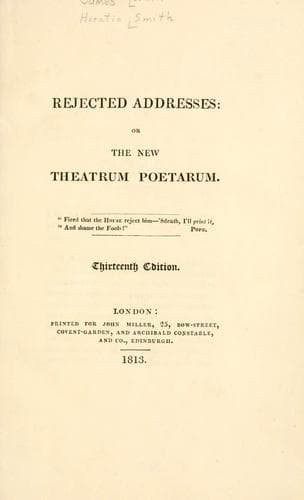
Rejected Addresses; Or, The New Theatrum PoetarumSmith, James
General
Rejected Addresses; Or, The New Theatrum Poetarum
Smith, James
Parodies
{93} “We come next to three ludicrous parodies—of the story of _The
Stranger_, of _George Barnwell_, and of the dagger-scene in Macbeth,
under the signature of Momus Medlar. They are as good, we think, as that
sort of thing can be, and remind us of the happier efforts of Colman,
whose less successful fooleries are professedly copied in the last piece
in the volume.”—JEFFREY, _Edinburgh Renew_.
{96} A translation from Kotzebue by Thompson, and first acted at Drury
Lane, 24th March, 1798. Mrs. Siddons was famous in the part of Mrs.
Haller.
{98} See Percy’s Reliques of Ancient English Poetry, vol. iii.; and
Lillo’s tragedy, “The London Merchant; or, the History of George
Barnwell.” 8vo. 1731.
{102} Theodore Hook, at that time a very young man, and the companion of
the annotator in many wild frolics. The cleverness of his subsequent
prose compositions has cast his early stage songs into oblivion. This
parody was, in the second edition, transferred from Colman to Hook.
{103a} Then Director of the Opera House.
{103b} At that time the chief dancer at this establishment.
{103c} Vauxhall Bridge then, like the Thames Tunnel at present [1833],
stood suspended in the middle of that river.
{72} Dr. Busby gave living recitations of his translation of
_Lucretius_, with tea and bread-and-butter. He sent in a real Address to
the Drury Lane committee, which was really rejected. The present
imitation professes to be recited by the translator’s son. The poet
here, again, was a prophet. A few evenings after the opening of the
Theatre Dr. Busby sat with his son in one of the stage-boxes. The latter
to the astonishment of the audience, at the end of the play, stepped from
the box upon the stage, with his father’s real rejected address in his
hand, and began to recite it as follows:—
“When energising objects men pursue,
What are the prodigies they cannot do?”
Raymond, the stage-manager, accompanied by a constable, at this moment
walked upon the stage, and handed away the juvenile _dilettante_
performer.
The Doctor’s classical translation was thus noticed in one of the
newspapers of the day, in the column of births:—“Yesterday, at his house
in Queen Anne-street, Dr. Busby of a still-born _Lucretius_.” [Bushy’s
Monologue was parodied by Lord Byron: see Byron’s works, p. 553.]
“In one single point the parodist has failed—there is a certain Dr.
Busby, whose supposed address is a translation called ‘Architectural
Atoms, intended to be recited by the translator’s son.’ Unluckily,
however, for the wag who had prepared this fun, the genuine serious
absurdity of Dr. Busby and his son has cast all his humour into the
shade. The Doctor from the boxes, and the son from the stage, have
actually endeavoured, it seems, to recite addresses, which they call
_monologues_ and _unalogues_; and which, for extravagant folly, tumid
meanness, and vulgar affectation, set all the powers of parody at utter
defiance.”—_Quarterly Review_.
Public-domain text, read in full here on John Shaqi.
Reviews
Reviews
No reviews yet
Be the first to share your thoughts on this work.
Elsewhere in the archive
Join the Discussion
Join the discussion
Sign in to leave a comment or review.
Sign InorCreate an account