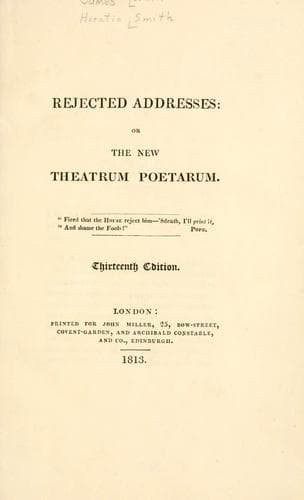
Rejected Addresses; Or, The New Theatrum PoetarumSmith, James
General
Rejected Addresses; Or, The New Theatrum Poetarum
Smith, James
Parodies
Willingly leaving this matter to the decision of the public, since we
cannot be umpires in our own cause, we proceed to detail such
circumstances attending the writing and publication of our little work,
as may literally meet the wishes of the present proprietor of the
copyright, who has applied to us for a gossiping Preface. Were we
disposed to be grave and didactic, which is as foreign to our mood as it
was twenty years ago, we might draw the attention of the reader, in a
fine sententious paragraph, to the trifles upon which the fate of
empires, as well as a four-and-sixpenny volume of parodies, occasionally
hangs in trembling balance. No sooner was the idea of our work
conceived, than it was about to be abandoned in embryo, from the
apprehension that we had no lime to mature and bring it forth, as it was
indispensable that it should be written, printed, and published by the
opening of Drury Lane Theatre, which would only allow us an interval of
six weeks, and we had both of us other avocations that precluded us from
the full command of even that limited period. Encouraged, however, by
the conviction that the thought was a good one, and by the hope of making
a lucky hit, we set to work _con amore_, our very hurry not improbably
enabling us to strike out at a heat what we might have failed to produce
so well, had we possessed time enough to hammer it into more careful and
elaborate form.
Our first difficulty, that of selection, was by no means a light one.
Some of our most eminent poets—such, for instance, as Rogers and
Campbell—presented so much beauty, harmony, and proportion in their
writings, both as to style and sentiment, that if we had attempted to
caricature them, nobody would have recognised the likeness; and if we had
endeavoured to give a servile copy of their manner, it would only have
amounted, at best, to a tame and unamusing portrait, which it was not our
object to present. Although fully aware that their names would, in the
theatrical phrase, have conferred great strength upon our bill, we were
reluctantly compelled to forego them, and to confine ourselves to writers
whose style and habit of thought, being more marked and peculiar, was
more capable of exaggeration and distortion. To avoid politics and
personality, to imitate the turn of mind as well as the phraseology of
our originals, and, at all events, to raise a harmless laugh, were our
main objects; in the attainment of which united aims, we were sometimes
hurried into extravagance, by attaching much more importance to the last
than to the two first. In no instance were we thus betrayed into a
greater injustice than in the case of Mr. Wordsworth—the touching
sentiment, profound wisdom, and copious harmony of whose loftier writings
we left unnoticed, in the desire of burlesquing them; while we pounced
upon his popular ballads, and exerted ourselves to push their simplicity
into puerility and silliness. With pride and pleasure do we now claim to
Public-domain text, read in full here on John Shaqi.
Reviews
Reviews
No reviews yet
Be the first to share your thoughts on this work.
Join the Discussion
Join the discussion
Sign in to leave a comment or review.
Sign InorCreate an account