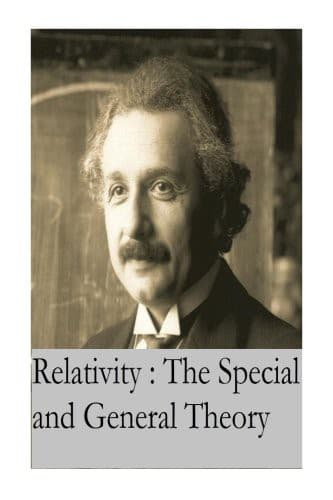
Relativity: The Special and General TheoryEinstein, Albert
Science
Relativity: The Special and General Theory
Einstein, Albert
Relativity (Physics)
Now before the advent of the theory of relativity it had always tacitly
been assumed in physics that the statement of time had an absolute
significance, _i.e._ that it is independent of the state of motion of
the body of reference. But we have just seen that this assumption is
incompatible with the most natural definition of simultaneity; if we
discard this assumption, then the conflict between the law of the
propagation of light _in vacuo_ and the principle of relativity
(developed in Section VII) disappears.
We were led to that conflict by the considerations of Section VI, which
are now no longer tenable. In that section we concluded that the man in
the carriage, who traverses the distance _w per second_ relative to the
carriage, traverses the same distance also with respect to the
embankment _in each second_ of time. But, according to the foregoing
considerations, the time required by a particular occurrence with
respect to the carriage must not be considered equal to the duration of
the same occurrence as judged from the embankment (as reference-body).
Hence it cannot be contended that the man in walking travels the
distance _w_ relative to the railway line in a time which is equal to
one second as judged from the embankment.
Moreover, the considerations of Section VI are based on yet a second
assumption, which, in the light of a strict consideration, appears to
be arbitrary, although it was always tacitly made even before the
introduction of the theory of relativity.
X.
ON THE RELATIVITY OF THE CONCEPTION OF DISTANCE
Let us consider two particular points on the train [8] travelling along
the embankment with the velocity _v_, and inquire as to their distance
apart. We already know that it is necessary to have a body of reference
for the measurement of a distance, with respect to which body the
distance can be measured up. It is the simplest plan to use the train
itself as reference-body (co-ordinate system). An observer in the train
measures the interval by marking off his measuring-rod in a straight
line (_e.g._ along the floor of the carriage) as many times as is
necessary to take him from the one marked point to the other. Then the
number which tells us how often the rod has to be laid down is the
required distance.
[8] _e.g._ the middle of the first and of the hundredth carriage.
Public-domain text, read in full here on John Shaqi.
Reviews
Reviews
No reviews yet
Be the first to share your thoughts on this work.
Join the Discussion
Join the discussion
Sign in to leave a comment or review.
Sign InorCreate an account